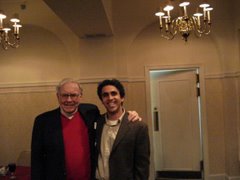
This a wonderful account by Warren Buffett given to Forbes magazine about his decision to form his original investment partnership in 1956 (a partnership model replicated by Gad Capital Management and Gad Partners Funds), a fateful decision that ultimately led to the genesis of what Berkshire Hathaway is today.
Titled "Warren Buffett's $50 Billion Decision" the story is below. Yet visit the link for great pictures of Buffett in his early years.
Warren Buffett's $50 Billion Decision
by Warren Buffett
http://www.forbes.com/sites/randalllane/2012/03/26/warren-buffetts-50-billion-decision/print/
Benjamin Graham had been my idol ever since I read hisbook The Intelligent Investor.I had wanted to go to Columbia Business Schoolbecause he was a professor there, and after I got out of Columbia, returned to Omaha, and startedselling securities, I didn’t forget about him. Between 1951 and 1954, I made apest of myself, sending him frequent securities ideas. Then I got a letterback: “Next time you’re in New York, come and see me.”
So there I went, and he offered me a job atGraham-Newman Corp., which he ran with Jerry Newman. Everyone says that A.W.Jones started the hedge fund industry, but Graham-Newman’s sister partnership,Newman and Graham, was actually an earlier fund. I moved to White Plains, NewYork, with my wife, Susie, who was four months pregnant, and my daughter. Everymorning, I got on a train to Grand Central and went to work.
It was a short-lived position: The next year, when Iwas 25, Mr. Graham—that’s what I called him then—gave me a heads-up that he wasgoing to retire. Actually, he did more than that: He offered me the chance toreplace him, with Jerry’s son Mickey as the new senior partner and me as thenew junior partner. It was a very tiny fund—$6 million or $7 million—but it wasa famous fund.
This was a traumatic decision. Here was my chance to stepinto the shoes of my hero—I even named my first son Howard Graham Buffett.(Howard was for my father.) But I also wanted to come back to Omaha. I probablywent to work for a month thinking every morning that I would tell Mr. Graham Iwas going to leave. But it was hard to do.
The thing is, when I got out of college, I had $9,800,but by the end of 1955, I was up to $127,000. I thought, I’ll go back to Omaha,take some college classes, and read a lot—I was going to retire! I figured wecould live on $12,000 a year, and off my $127,000 asset base, I could easilymake that. I told my wife, “Compound interest guarantees I’m going to getrich.”
My wife and kids went back to Omaha just ahead of me.I got in the car, and on my way west checked out companies I was interested ininvesting in. It was due diligence. I stopped in Hazleton, Pennsylvania, tovisit the Jeddo-Highland Coal Company. I visited the Kalamazoo Stove &Furnace Company in Michigan, which was being liquidated. I went to see what thebuilding looked like, what they had for sale. I went to Delaware, Ohio, tocheck out Greif Bros. Cooperage. (Who knows anything about cooperage anymore?)Its chairman met with me. I didn’t have appointments; I would just drop in. Ifound that people always talked to me. All these people helped me.
In Omaha, I rented a house at 5202 Underwood for $175a month. I told my wife, “I’d be glad to buy a house, but that’s like acarpenter selling his toolkit.” I didn’t want to use up my capital.
I had no plans to start a partnership, or even have ajob. I had no worries as long as I could operate on my own. I certainly did notwant to sell securities to other people again. But by pure accident, sevenpeople, including a few of my relatives, said to me, “You used to sell stocks,and we want you to tell us what to do with our money.” I replied, “I’m notgoing to do that again, but I’ll form a partnership like Ben and Jerry had, andif you want to join me, you can.” My father-in-law, my college roommate, hismother, my aunt Alice, my sister, my brother-in-law, and my lawyer all signedon. I also had my hundred dollars. That was the beginning—totally accidental.
When I formed that partnership, we had dinner, theseven of them plus me—I’m 99 percent sure it was at the Omaha Club. I bought aledger for 49 cents, and they brought their checks. Before I took their money,I gave them a half sheet of paper that I had made carbons of—something I calledthe ground rules. I said, “There are two or four pages of partnership legaldocuments. Don’t worry about that. I’ll tell you what’s in it, and you won’tget any surprises.
“But these ground rules are the philosophy. If you are in tune with me, thenlet’s go. If you aren’t, I understand. I’m not going to tell you what we own oranything like that. I want to get bouquets when I deserve bouquets, and I wantto get soft fruit thrown at me when I deserve it. But I don’t want fruit thrownat me if I’m down 5 percent, and the market’s down 15 percent—I’m going tothink I deserve a bouquet for that.” We made everything clear, and they gave metheir checks.
I did no solicitation, but more checks began comingfrom people I didn’t know. Back in New York, Graham-Newman was beingliquidated. There was a college president up in Vermont, Homer Dodge, who had beeninvested with Graham, and he asked, “Ben, what should I do with my money?” Bensaid, “Well, there’s this kid who used to work for me.…” So Dodge drove out toOmaha, to this rented house I lived in. I was 25, looked about 17, and actedlike 12. He said, “What are you doing?” I said, “Here’s what I’m doing with myfamily, and I’ll do it with you.”
Although I had no idea, age 25 was a turning point. Iwas changing my life, setting up something that would turn into a fairlygood-size partnership called Berkshire Hathaway. I wasn’t scared. I was doingsomething I liked, and I’m still doing it.
http://www.forbes.com/sites/randalllane/2012/03/26/warren-buffetts-50-billion-decision/print/
Tuesday, March 27, 2012


Tuesday, March 20, 2012
The Special Situation Case for Rentech
Not one to usually share ideas (solely so that I can take ownership for Gad Capital's, Gad Partners Funds, and the Sham Gad Family successes and failures), here's is an idea that will appear intriguing to some while dismissed by others. It's simple in concept.
Rentech (RTK), trades at $2 a share or a market cap of $450 million. Rentech's marketable assets are worth nearly $600 million, 33% above the company's current market cap. Add in another $ million or so in net cash on the balance sheet and you have a business that aside from operations should be worth more than $800 million, or a 70% upside, if the company announced a liquidation, although there are no immediate plans to do that.
Rentech provides clean energy solutions through the production of synthetic fuels, a business is not yet commercially viable for Rentech. Management appears to "get it" and plans to reduce capital expenditures by 85% in fiscal 2012 along with a 50% reduction in R&D. Without this decision, I would have argued that the business was eroding value.
The not so hidden gem is the nitrogen fertilizer business, Rentech Nitrogen Partners (RNF) spun out last November. Rentech received around $140 million in cash from the IPO and maintained a 61% equity interest, or 23.25 units in Rentech Nitrogen.
Today, Rentech Nitrogen trades for a market valuation of $990 million, which places Rentech's 61% stake at a value of around $600 million. As an MLP, Rentech Nitrogen plans to distribute out all its available cash flows which according to company guidance, will be $2.34 a unit in 2012. Given the slowdown in the fertilizer industry, it's possible that this initial distribution will come in lower than expected although I should note that nitrogen fertilizer prices continue to hold up along with the fact that RNF has a majority of its production hedged at prices that would support the implied distribution.
In short, Rentech owns 61% of a very attractive cash-generating business and will collect a nice dividend with each payout (over $50 million at the implied distribution). Rentech's balance sheet consists of $240 million in cash (around $40 million at Nitrogen) and $50 million in debt, or a net cash position of about $190 million. Add in the current market value of Rentech Nitrogen stake, $600 million, and you get a value of $790 million.
I assume that the energy business is value destroying; however, one should note that the energy segment sits on $90 million in federal net operating loss carry-forwards which can be used to offset taxable income, including any distributions from income from Rentech Nitrogen. Rentech is a cash- and asset-rich investment play that should be conservatively worth between $600 million and $750 million, or $2.70 to $3.50 a share.
There you have it, enough information to wet your whistle. There's more to the story, but better to teach a man to fish than give him one.
Disclosure: Long RTK
Rentech (RTK), trades at $2 a share or a market cap of $450 million. Rentech's marketable assets are worth nearly $600 million, 33% above the company's current market cap. Add in another $ million or so in net cash on the balance sheet and you have a business that aside from operations should be worth more than $800 million, or a 70% upside, if the company announced a liquidation, although there are no immediate plans to do that.
Rentech provides clean energy solutions through the production of synthetic fuels, a business is not yet commercially viable for Rentech. Management appears to "get it" and plans to reduce capital expenditures by 85% in fiscal 2012 along with a 50% reduction in R&D. Without this decision, I would have argued that the business was eroding value.
The not so hidden gem is the nitrogen fertilizer business, Rentech Nitrogen Partners (RNF) spun out last November. Rentech received around $140 million in cash from the IPO and maintained a 61% equity interest, or 23.25 units in Rentech Nitrogen.
Today, Rentech Nitrogen trades for a market valuation of $990 million, which places Rentech's 61% stake at a value of around $600 million. As an MLP, Rentech Nitrogen plans to distribute out all its available cash flows which according to company guidance, will be $2.34 a unit in 2012. Given the slowdown in the fertilizer industry, it's possible that this initial distribution will come in lower than expected although I should note that nitrogen fertilizer prices continue to hold up along with the fact that RNF has a majority of its production hedged at prices that would support the implied distribution.
In short, Rentech owns 61% of a very attractive cash-generating business and will collect a nice dividend with each payout (over $50 million at the implied distribution). Rentech's balance sheet consists of $240 million in cash (around $40 million at Nitrogen) and $50 million in debt, or a net cash position of about $190 million. Add in the current market value of Rentech Nitrogen stake, $600 million, and you get a value of $790 million.
I assume that the energy business is value destroying; however, one should note that the energy segment sits on $90 million in federal net operating loss carry-forwards which can be used to offset taxable income, including any distributions from income from Rentech Nitrogen. Rentech is a cash- and asset-rich investment play that should be conservatively worth between $600 million and $750 million, or $2.70 to $3.50 a share.
There you have it, enough information to wet your whistle. There's more to the story, but better to teach a man to fish than give him one.
Disclosure: Long RTK
Monday, March 12, 2012
Berkshire Hathaway Analysis: Still Relevant Today
by Sham Gad
It's widely known that very few analysts attempt to follow or analyze Berkshire Hathaway. That's perfectly alright with Warren Buffett. Here at Gad Capital and the Gad Partners Funds, it is more than satisfactory to rely on the company's annual reports and Buffett's annual letter. Rarely does a CEO devote dozens on pages each year educating his shareholders are about how to value a business, including Berkshire Hathaway.
But one analyst report back in 1999 earned Buffett's stamp of approval. It was written by none other than Alice Schroeder, whom Buffett picked several years ago to pen his biography. Despite being penned in 1999, the analysis is as relevant as ever because the report does a magnificent job of educating the reader on how value Berkshire from four perspectives. Those perspectives are the same ones Buffett applies today and always.
The report in its entirety can be read by clicking here. It's a must read for anyone interested in investing.
It's widely known that very few analysts attempt to follow or analyze Berkshire Hathaway. That's perfectly alright with Warren Buffett. Here at Gad Capital and the Gad Partners Funds, it is more than satisfactory to rely on the company's annual reports and Buffett's annual letter. Rarely does a CEO devote dozens on pages each year educating his shareholders are about how to value a business, including Berkshire Hathaway.
But one analyst report back in 1999 earned Buffett's stamp of approval. It was written by none other than Alice Schroeder, whom Buffett picked several years ago to pen his biography. Despite being penned in 1999, the analysis is as relevant as ever because the report does a magnificent job of educating the reader on how value Berkshire from four perspectives. Those perspectives are the same ones Buffett applies today and always.
The report in its entirety can be read by clicking here. It's a must read for anyone interested in investing.
Wednesday, February 22, 2012
One of the Greatest Ever
A true loss for the value investing community took place last week when legendary investor Walter Schloss passed away. Without greats like Walter Schloss, there would be no Gad Capital Management, Sham Gad Partners Funds, or anything else I have done related to investing.
About four years ago I had the distinct pleasure of hearing Schloss speak in New York. This was a gem of an experience - I think I was one of maybe 10 people getting to hear the living legend speak on value investing, Ben Graham, Warren Buffett, and many other great stories. My biggest takeaway: schloss's deep disregard for debt. He kept making the comment and I quote "I just don't like debt. There is too much trouble in having debt". Little did I know that Walter's cooments were a timeless lessons that would come to manifest themselves several months later.
I count myself among the lucky few who were able to meet and speak with Mr. Schloss.
Here's a great piece on Schloss from Bloomberg: (I've abridged this...click to go to full article)
From 1955 to 2002, by Schloss’s estimate, his investments returned 16 percent annually on average after fees, compared with 10 percent for the Standard & Poor’s 500 Index. (SPX) His firm, Walter J. Schloss Associates, became a partnership, Walter & Edwin Schloss Associates, when his son joined him in 1973. Schloss retired in 2002.
Buffett, a Graham disciple whose stewardship of Berkshire Hathaway Inc. has made him one of the world’s richest men and most emulated investors, called Schloss a “superinvestor” in a 1984 speech at Columbia Business School. He again saluted Schloss as “one of the good guys of Wall Street” in his 2006 letter to Berkshire Hathaway shareholders.
“Walter Schloss was a very close friend for 61 years,” Buffett said yesterday in a statement. “He had an extraordinary investment record, but even more important, he set an example for integrity in investment management. Walter never made a dime off of his investors unless they themselves made significant money. He charged no fixed fee at all and merely shared in their profits. His fiduciary sense was every bit the equal of his investment skills.”
Began as ‘Runner’
To Buffett, Schloss’s record disproved the theory of an efficient market -- one that, at any given moment, assigns a reasonably accurate price to a stock. If companies weren’t routinely overvalued and undervalued, Buffett reasoned, long- term results like Schloss’s couldn’t be achieved, except through inside information. Schloss, who never attended college, began working on Wall Street in 1935 as a securities-delivery “runner” at Carl M. Loeb & Co.
The Schloss theory of investing, passed from father to son, involved minimal contact with analysts and company management and maximum scrutiny of financial statements, with particular attention to footnotes.
Focus on Statements
“The Schlosses would rather trust their own analysis and their longstanding commitment to buying cheap stocks,” Bruce Greenwald, Judd Kahn, Paul Sonkin and Michael van Biema wrote in “Value Investing: From Graham to Buffett and Beyond,” their 2001 book. “This approach,” the authors wrote, “leads them to focus almost exclusively on the published financial statements that public firms must produce each quarter. They start by looking at the balance sheet. Can they buy the company for less than the value of the assets, net of all debt? If so, the stock is a candidate for purchase.”
An example was copper company Asarco Inc. The Schlosses bought shares in 1999 as the stock bottomed out around $13. In November of that year, Grupo Mexico SA (GMEXICOB) bought Asarco for $2.25 billion in cash and assumed debt, paying almost $30 a share.
‘Guts to Buy’
“Basically we like to buy stocks which we feel are undervalued, and then we have to have the guts to buy more when they go down,” Schloss said at a 1998 conference sponsored by Grant’s Interest Rate Observer. “And that’s really the history of Ben Graham.” Buffett, in his 2006 letter to shareholders, said Schloss took “no real risk, defined as permanent loss of capital” and invested “in about 1,000 securities, mostly of a lackluster type. A few big winners did not account for his success.”
Edwin Schloss, now retired, said yesterday in an interview that his father’s investing philosophy and longevity were probably related. “A lot of money managers today worry about quarterly comparisons in earnings,” he said. “They’re up biting their fingernails until 5 in the morning. My dad never worried about quarterly comparisons. He slept well.”
Early Lessons
Schloss first met Buffett at an annual meeting of wholesaler Marshall Wells, which drew both investors because it was trading at a discount to net working capital, according to a 2008 article in Forbes magazine. When Buffett joined Graham- Newman, he and Schloss shared an office. While Buffett became a star inside the firm, Schloss was “pigeonholed as a journeyman employee who would never rise to partnership,” Schroeder, a Bloomberg News columnist, wrote in her book.
About four years ago I had the distinct pleasure of hearing Schloss speak in New York. This was a gem of an experience - I think I was one of maybe 10 people getting to hear the living legend speak on value investing, Ben Graham, Warren Buffett, and many other great stories. My biggest takeaway: schloss's deep disregard for debt. He kept making the comment and I quote "I just don't like debt. There is too much trouble in having debt". Little did I know that Walter's cooments were a timeless lessons that would come to manifest themselves several months later.
I count myself among the lucky few who were able to meet and speak with Mr. Schloss.
Here's a great piece on Schloss from Bloomberg: (I've abridged this...click to go to full article)
From 1955 to 2002, by Schloss’s estimate, his investments returned 16 percent annually on average after fees, compared with 10 percent for the Standard & Poor’s 500 Index. (SPX) His firm, Walter J. Schloss Associates, became a partnership, Walter & Edwin Schloss Associates, when his son joined him in 1973. Schloss retired in 2002.
Buffett, a Graham disciple whose stewardship of Berkshire Hathaway Inc. has made him one of the world’s richest men and most emulated investors, called Schloss a “superinvestor” in a 1984 speech at Columbia Business School. He again saluted Schloss as “one of the good guys of Wall Street” in his 2006 letter to Berkshire Hathaway shareholders.
“Walter Schloss was a very close friend for 61 years,” Buffett said yesterday in a statement. “He had an extraordinary investment record, but even more important, he set an example for integrity in investment management. Walter never made a dime off of his investors unless they themselves made significant money. He charged no fixed fee at all and merely shared in their profits. His fiduciary sense was every bit the equal of his investment skills.”
Began as ‘Runner’
To Buffett, Schloss’s record disproved the theory of an efficient market -- one that, at any given moment, assigns a reasonably accurate price to a stock. If companies weren’t routinely overvalued and undervalued, Buffett reasoned, long- term results like Schloss’s couldn’t be achieved, except through inside information. Schloss, who never attended college, began working on Wall Street in 1935 as a securities-delivery “runner” at Carl M. Loeb & Co.
The Schloss theory of investing, passed from father to son, involved minimal contact with analysts and company management and maximum scrutiny of financial statements, with particular attention to footnotes.
Focus on Statements
“The Schlosses would rather trust their own analysis and their longstanding commitment to buying cheap stocks,” Bruce Greenwald, Judd Kahn, Paul Sonkin and Michael van Biema wrote in “Value Investing: From Graham to Buffett and Beyond,” their 2001 book. “This approach,” the authors wrote, “leads them to focus almost exclusively on the published financial statements that public firms must produce each quarter. They start by looking at the balance sheet. Can they buy the company for less than the value of the assets, net of all debt? If so, the stock is a candidate for purchase.”
An example was copper company Asarco Inc. The Schlosses bought shares in 1999 as the stock bottomed out around $13. In November of that year, Grupo Mexico SA (GMEXICOB) bought Asarco for $2.25 billion in cash and assumed debt, paying almost $30 a share.
‘Guts to Buy’
“Basically we like to buy stocks which we feel are undervalued, and then we have to have the guts to buy more when they go down,” Schloss said at a 1998 conference sponsored by Grant’s Interest Rate Observer. “And that’s really the history of Ben Graham.” Buffett, in his 2006 letter to shareholders, said Schloss took “no real risk, defined as permanent loss of capital” and invested “in about 1,000 securities, mostly of a lackluster type. A few big winners did not account for his success.”
Edwin Schloss, now retired, said yesterday in an interview that his father’s investing philosophy and longevity were probably related. “A lot of money managers today worry about quarterly comparisons in earnings,” he said. “They’re up biting their fingernails until 5 in the morning. My dad never worried about quarterly comparisons. He slept well.”
Early Lessons
Schloss first met Buffett at an annual meeting of wholesaler Marshall Wells, which drew both investors because it was trading at a discount to net working capital, according to a 2008 article in Forbes magazine. When Buffett joined Graham- Newman, he and Schloss shared an office. While Buffett became a star inside the firm, Schloss was “pigeonholed as a journeyman employee who would never rise to partnership,” Schroeder, a Bloomberg News columnist, wrote in her book.
Wednesday, February 8, 2012
How to Beat the Market? Avoid It.
If I challenged you to take on Tiger Woods, how would you beat him? You may think I’m asking an idiotic question, but in actuality there is some great value to be learned here. The fact is Tiger is beatable and I know how to beat him: by not playing him in golf.
As long as you take on the world’s best golfer in anything but golf, odds are you stand a good chance of winning. Think about this idea for a moment with respect to the stock market and investing. Your best chance of beating the market is by avoiding it. Let me explain.
Today’s market environment is dominated by institutional money collectively managing trillions of dollars. These large funds demand equity research, analyst estimates, and other investment decision related needs. These services are gladly provided by the hundreds of equity research firms and investment banks who exist solely to cater to these needs.
Because these investment funds are dealing with large pools of capital, they are looking for places to allocate tens of millions if not hundreds of millions of dollars in a relatively short amount of time. As a result, the vast majority of investment capital is playing in the same sandbox. And that sandbox is filled with larger cap companies that most are familiar with. There is nothing wrong with this approach; in fact by default it’s the only approach to follow if you are part of a large pool of investment capital.
Luckily for the individual investor or smaller account (sub $200 - $300 million), you don’t have to play in this sandbox. In fact, in most cases you should try to avoid it because chances are that you will have no edge over the other players. In other words, there is a higher degree of efficiency when you have more participants.
Of course when an opportunity like the financial crisis of 2008 leads to a market wide sell off and everything is on sale, that’s a different story. When you can buy a company like Apple for $90 in the midst of a market panic as you could have two years ago, you pull the trigger quickly. Or when Whole Foods (WFMI) was trading for under $10 a share in late 2008 after having earned $1.30 in 2007, you didn’t need to think hard about the value proposition. But those opportunities don’t come along so often.
Today, financials offer the same home-run type opportunities but will likely take a little longer to play out. I would argue that Bank of America (BAC) for those investors with a 2-3 horizon will profit handsomely at today's current valuation.
There is ample opportunity, however, where the big boys can't look. A $10 billion investmetn fund is not going to be spending a lot of time looking at companies with market caps below $500 million. And as a result, most analysts who service them aren't looking there either.
There is ample opportunity, however, where the big boys can't look. A $10 billion investmetn fund is not going to be spending a lot of time looking at companies with market caps below $500 million. And as a result, most analysts who service them aren't looking there either.
Don’t make investing harder than it already is. Leave the big boys to fight over the big fish while you focus on the easy pickings of the smaller and potentially more lucrative opportunities. Happy hunting!
Wednesday, February 1, 2012
Investing in Quality Always Takes the Cake
Warren Buffett has spent the past 60 years amassing an untouchable investment record. His endurance through recessions, market bubbles, and financial panics is what truly sets him apart in the game. Buffett is indeed a value investor. When I apply the term value investor to Buffett, the definition I give is the response Buffett gives: what other type of investing is there if it isn't the act of seeking value?
The concept of value investing as the only type of investing is a profound statement and one I hang my hat on here at Gad Capital Management. For the first 15 years or so in his life, Buffett made his money buying cheap, low quality cigar butts that pocketed him 20% - 30% gains in a relatively short period of time. That beginning gave Buffett his name. What made his career was a entirely different approach that he has honed in on for nearly 50 years: buying quality businesses at slightly undervalued or fairly valued prices.
To most value investors, buying a fairly valued security seems contradictory to the value investing approach. On the contrary, I would opine that what gets many "value investors" in trouble is sticking to statistically cheap stocks and ignoring the value in quality stocks trading at reasonable valuations.
The ultimate key to value is, of course, price. But if you buy a statistically cheap stock without any value creating catalyst, you many find yourself waiting a very long-time for that value to be unlocked. On the other hand if you are able to buy a quality issue at a reasonable price, you may come to find a lot of value creation over the years that such an investment is held.
Indeed, one of the best types of a margin of safety is quality. Indeed, the man himself speaks exactly to that point. In Chapter 20 of The Intelligent Investors, Ben Graham suggests:
Indeed if you buy an excellent business trading at 90% of intrinsic value but that company can grow its future cash flows, then isn't intrinsic value going to increase over time, thus giving you a wider margin of safety? Isn't this the case with Apple (NASDAQ: AAPL), which out of great irony, has never traded at a nosebleed valuation over the past several years despite producing the type of growth rates that any tech company would dream for? In the company's most recent quarter, it generated $13 billion in net profit, almost the amount of income generated in all of fiscal 2010. Isn't a company with that growth potential and high quality trading at 20 times earnings a better value proposition than a single digit P/E, low book value stock that may suffer losses at the first sign of economic trouble?
I've learned this lesson the hard way with my personal example, Chipotle Mexican Grill (NYSE: CMG). If it's lunch or dinner time and there is a Chipotle with 15 miles, that is where I am going. And apparently so are hundreds of other people all throughout the day. Chipotle, by all measures, is a fantastic business in an industry that is not all that fantastic. Chipotle takes fine dining type food and sells it quickly and at a very attractive price. I have been the biggest advocate for this company to anyone I talk to. (Steve Els, if you happen to read this, I just want you to know that Sham Gad has probably turned on over 100 people to Chipotle who probably eat there twice a week.)
Yet what was glaringly obvious to me from a business perspective was not so obvious from an investment perspective because I anchored too much on numerical quality and not enough on qualitative attributes. So when the Great Recession gave me a chance to buy Chipotle at $130, or 20 times earnings, I stalled. Fast forward three years later and what Chipotle is earning now equates to about 12 times earnings that share price. (As a consolation, my hometown is getting its first Chipotle in 2012, which I hope will serve as a constant reminder of my error of commission.)
It is precisely this approach to investing that led Buffett to See's Candies, Coca-Cola, The Burlington Northern, and most recently, to committing $10 billion to IBM. When Buffett bought The Burlington Northern, esteemed value investors took him to task as paying too much for a capital intensive business. Now the consensus is that he bought the railroad for half of what it would sell for today.
Making investments casts a wide net. Special situation opportunities like my recent discussion on Premier Exhibitions (PRXI) doesn't fit the mold of quality per se, but it does pass the test of probability. After all, investing is nothing more than a probabilistic exercise. What quality does is skew the probability of a favorable outcome squarely on the side of the value oriented investor.
The concept of value investing as the only type of investing is a profound statement and one I hang my hat on here at Gad Capital Management. For the first 15 years or so in his life, Buffett made his money buying cheap, low quality cigar butts that pocketed him 20% - 30% gains in a relatively short period of time. That beginning gave Buffett his name. What made his career was a entirely different approach that he has honed in on for nearly 50 years: buying quality businesses at slightly undervalued or fairly valued prices.
To most value investors, buying a fairly valued security seems contradictory to the value investing approach. On the contrary, I would opine that what gets many "value investors" in trouble is sticking to statistically cheap stocks and ignoring the value in quality stocks trading at reasonable valuations.
The ultimate key to value is, of course, price. But if you buy a statistically cheap stock without any value creating catalyst, you many find yourself waiting a very long-time for that value to be unlocked. On the other hand if you are able to buy a quality issue at a reasonable price, you may come to find a lot of value creation over the years that such an investment is held.
Indeed, one of the best types of a margin of safety is quality. Indeed, the man himself speaks exactly to that point. In Chapter 20 of The Intelligent Investors, Ben Graham suggests:
However, the risk of paying too high a price for good-quality stocks - while a real one - is not the chief hazard confronting the average buyer of securities. Observation over many years has taught us that the chief losses to investors come from the purchase of low-quality securities at times of favorable business conditions....These securities do not offer an adequate margin of safety in any admissible sense of the term. (emphasis added)
Indeed if you buy an excellent business trading at 90% of intrinsic value but that company can grow its future cash flows, then isn't intrinsic value going to increase over time, thus giving you a wider margin of safety? Isn't this the case with Apple (NASDAQ: AAPL), which out of great irony, has never traded at a nosebleed valuation over the past several years despite producing the type of growth rates that any tech company would dream for? In the company's most recent quarter, it generated $13 billion in net profit, almost the amount of income generated in all of fiscal 2010. Isn't a company with that growth potential and high quality trading at 20 times earnings a better value proposition than a single digit P/E, low book value stock that may suffer losses at the first sign of economic trouble?
I've learned this lesson the hard way with my personal example, Chipotle Mexican Grill (NYSE: CMG). If it's lunch or dinner time and there is a Chipotle with 15 miles, that is where I am going. And apparently so are hundreds of other people all throughout the day. Chipotle, by all measures, is a fantastic business in an industry that is not all that fantastic. Chipotle takes fine dining type food and sells it quickly and at a very attractive price. I have been the biggest advocate for this company to anyone I talk to. (Steve Els, if you happen to read this, I just want you to know that Sham Gad has probably turned on over 100 people to Chipotle who probably eat there twice a week.)
Yet what was glaringly obvious to me from a business perspective was not so obvious from an investment perspective because I anchored too much on numerical quality and not enough on qualitative attributes. So when the Great Recession gave me a chance to buy Chipotle at $130, or 20 times earnings, I stalled. Fast forward three years later and what Chipotle is earning now equates to about 12 times earnings that share price. (As a consolation, my hometown is getting its first Chipotle in 2012, which I hope will serve as a constant reminder of my error of commission.)
It is precisely this approach to investing that led Buffett to See's Candies, Coca-Cola, The Burlington Northern, and most recently, to committing $10 billion to IBM. When Buffett bought The Burlington Northern, esteemed value investors took him to task as paying too much for a capital intensive business. Now the consensus is that he bought the railroad for half of what it would sell for today.
Making investments casts a wide net. Special situation opportunities like my recent discussion on Premier Exhibitions (PRXI) doesn't fit the mold of quality per se, but it does pass the test of probability. After all, investing is nothing more than a probabilistic exercise. What quality does is skew the probability of a favorable outcome squarely on the side of the value oriented investor.
Saturday, January 28, 2012
Premier Exhibitions Finally Get It's Big Payoff in 2012
by Sham Gad
I'm usually not one to discuss positions in businesses we own until after I have exited them, but since I have readily discussed Premier Exhibitions (Nasdaq: PRXI) to the investors of Gad Partners Fund in numerous letters to partners, this information won't be new to any of them (or many others who have followed PRXI for that matter.) Besides, if all goes well, the thesis will play out in a manner of months. Even still, there is a high probability that shares remain significantly undervalued.
NOTE: The Gad Partners Fund as well as personal accounts of Sham Gad have established positions in this security at prices, that in most cases, are significantly below today's market price.
--------------
PRXI: Not Too Late to Cash In
Premier is a provider of high-quality museum-type exhibitions. The company's two best-known exhibits are BODIES and TheTitanic. The value-creating catalyst resides in the Titanic assets. Premier's subsidiary owns approximately 6,000 Titanic artifacts, acquired through years of diving and exploration. It is those assets that provide the current catalyst that will drive the company's valuation higher in the very near future.
In December 2011, Premier announced its intent to auction off its Titanic assets in April 2012, the 100th anniversary of the ships sinking. For more than 10 years, Premier has been involved in litigation regarding the title to those artifacts. Last August, a court finally awarded Premier the remaining set of artifacts it did not own. During that legal process, professional appraisers valued those artifacts in excess of $110 million. Those artifacts, along with the others in Premier's possession, are collectively worth $190 million.
Premier is debt free and has a market cap approaching $100 million. News of the Titanic auction did not move shares much -- a signal that the market believes that the auction will not even fetch appraised value for the assets. I believe the market has it wrong; in fact, it's likely that the auction will result in a sale price in excess of the appraised value.
Consider the following:
I have spoken with management on numerous occasions. They get the tax issue and are squarely focused on managing any taxable transaction in order to maximize shareholder value.
Is there a chance that the auction doesn't succeed? Sure, there is always an element of uncertainty involved in any investment thesis. But if you look at PRXI's track record since Mark Sellers took control, they have accomplished everything they set out to do with respect to the Titanic assets. I for one, ascribe little value to the exhibition business for purposes of the valuation, but keep in mind that the exhibition business could be of enormous utility to anyone who owns the artifacts.
Successful investing requires building mental models and using those models to construct a story. In the case of Premier, one has think of who might be interested in owning not merely assets of a sunken ship, but arguably the most historic maritime tragedy in the world. A 15 year court saga is merely but one clue as to how significant these assets are deemed. At one point, Jerry Jones, owner of the Dallas Cowboys, was interested in having the massive Titanic hull at the new Cowboy stadium. In terms of historical significance and public curiosity, Titanic is right up there with King Tut, the most successful exhibit of all time. Use your imagination as to who want to own such a collection. My initial thought is that some affiliation with a museum or philanthropic organization is what will happen. I like to get really creative and think that a Steve Wynn type buyer could really be interested and bring this collection to his casinos.
By definition, an auction of any kind is a bet on an uncertain outcome. Auctions can and do flop. Investing is ultimately a probabilistic bet. I deem a worst a case scenario being the assets get sold at appraised value with a tax hit: in that case shares are probably worth 10% to 20% above the current price. Given management's keen focus on structuring any sale in the most advantageous manner suggest that even a worst Case outcome will be better than my assumptions.
An interesting point to keep in mind: because shares trade below $5, many mutual finds are prevented from owning shares. A reverse split could change that dynamic very quickly.
Disclosure: Both Gad Partners Fund and Sham Gad hold a long position in PRXI.
I'm usually not one to discuss positions in businesses we own until after I have exited them, but since I have readily discussed Premier Exhibitions (Nasdaq: PRXI) to the investors of Gad Partners Fund in numerous letters to partners, this information won't be new to any of them (or many others who have followed PRXI for that matter.) Besides, if all goes well, the thesis will play out in a manner of months. Even still, there is a high probability that shares remain significantly undervalued.
NOTE: The Gad Partners Fund as well as personal accounts of Sham Gad have established positions in this security at prices, that in most cases, are significantly below today's market price.
--------------
PRXI: Not Too Late to Cash In
Premier is a provider of high-quality museum-type exhibitions. The company's two best-known exhibits are BODIES and TheTitanic. The value-creating catalyst resides in the Titanic assets. Premier's subsidiary owns approximately 6,000 Titanic artifacts, acquired through years of diving and exploration. It is those assets that provide the current catalyst that will drive the company's valuation higher in the very near future.
In December 2011, Premier announced its intent to auction off its Titanic assets in April 2012, the 100th anniversary of the ships sinking. For more than 10 years, Premier has been involved in litigation regarding the title to those artifacts. Last August, a court finally awarded Premier the remaining set of artifacts it did not own. During that legal process, professional appraisers valued those artifacts in excess of $110 million. Those artifacts, along with the others in Premier's possession, are collectively worth $190 million.
Premier is debt free and has a market cap approaching $100 million. News of the Titanic auction did not move shares much -- a signal that the market believes that the auction will not even fetch appraised value for the assets. I believe the market has it wrong; in fact, it's likely that the auction will result in a sale price in excess of the appraised value.
Consider the following:
- In October 2011, Phillip Weiss Auctions offered artifacts from a couple who were honeymooning on the Titanic. Those artifacts were estimated to fetch between $30,000 and $50,000. Those artifacts sold for $100,570.
- That same month, England's Henry Aldridge & Son auctioned several Titanic artifacts, including a deck plan of First Class Accommodations used by a survivor. It was estimated that the deck plan would fetch between $50,000 and $80,000. The final sale price was more than $150,000.
I have spoken with management on numerous occasions. They get the tax issue and are squarely focused on managing any taxable transaction in order to maximize shareholder value.
Is there a chance that the auction doesn't succeed? Sure, there is always an element of uncertainty involved in any investment thesis. But if you look at PRXI's track record since Mark Sellers took control, they have accomplished everything they set out to do with respect to the Titanic assets. I for one, ascribe little value to the exhibition business for purposes of the valuation, but keep in mind that the exhibition business could be of enormous utility to anyone who owns the artifacts.
Successful investing requires building mental models and using those models to construct a story. In the case of Premier, one has think of who might be interested in owning not merely assets of a sunken ship, but arguably the most historic maritime tragedy in the world. A 15 year court saga is merely but one clue as to how significant these assets are deemed. At one point, Jerry Jones, owner of the Dallas Cowboys, was interested in having the massive Titanic hull at the new Cowboy stadium. In terms of historical significance and public curiosity, Titanic is right up there with King Tut, the most successful exhibit of all time. Use your imagination as to who want to own such a collection. My initial thought is that some affiliation with a museum or philanthropic organization is what will happen. I like to get really creative and think that a Steve Wynn type buyer could really be interested and bring this collection to his casinos.
By definition, an auction of any kind is a bet on an uncertain outcome. Auctions can and do flop. Investing is ultimately a probabilistic bet. I deem a worst a case scenario being the assets get sold at appraised value with a tax hit: in that case shares are probably worth 10% to 20% above the current price. Given management's keen focus on structuring any sale in the most advantageous manner suggest that even a worst Case outcome will be better than my assumptions.
An interesting point to keep in mind: because shares trade below $5, many mutual finds are prevented from owning shares. A reverse split could change that dynamic very quickly.
Disclosure: Both Gad Partners Fund and Sham Gad hold a long position in PRXI.
Thursday, January 26, 2012
What Investors Really Need to Know About Shareholder Activism
Corporate attorney Derek Bork at Thompson Hine recently released a gem of an article on shareholder activism. The article is a fascinating insight into one of the most intriguing aspects of investing today. Shareholder activism is not only the Carl Icahn type procedure you see today. Buffett in his early days was a huge activist in many of the investments he made for the Buffett Partnerships.
Most importantly, Mr. Bork's article is a refreshing illustration that successful activism is not only an arena for the large institutional investor or hedge fund, but for the smaller investor as well. With having a clear strategy and plan in mind, activism can clearly back fire, costing investors valuable time and money. Small or big, anyone interested in activism would be well advised to consider the blue print laid out by Mr. Bork.
"One of the biggest mistakes that some activist investors make is engaging in activist tactics without a clear strategy. It is easy to see the tactics that other activists use in the marketplace, but it is not always clear on the surface why they are using them. The tactics that an investor should use may vary widely from one situation to another, depending on the circumstances of the company, its legal defenses, the size of the investor’s position, the make-up of the shareholder base and other factors."
Read the article here.
Most importantly, Mr. Bork's article is a refreshing illustration that successful activism is not only an arena for the large institutional investor or hedge fund, but for the smaller investor as well. With having a clear strategy and plan in mind, activism can clearly back fire, costing investors valuable time and money. Small or big, anyone interested in activism would be well advised to consider the blue print laid out by Mr. Bork.
"One of the biggest mistakes that some activist investors make is engaging in activist tactics without a clear strategy. It is easy to see the tactics that other activists use in the marketplace, but it is not always clear on the surface why they are using them. The tactics that an investor should use may vary widely from one situation to another, depending on the circumstances of the company, its legal defenses, the size of the investor’s position, the make-up of the shareholder base and other factors."
Read the article here.
Tuesday, July 5, 2011
Avoid the Market to Attain Superior Investment Results, Part 2
The first part of this two-part article illustrated the importance of gaining an edge in investing. So how do the considerations and thoughts from Part I factor into my thinking with respect to gaining an edge? I can best explain my approach through a simple question: If asked to beat Phil Mickelson, how would you do it? You do it by not playing him in golf. Consider this analogy with respect to the stock market. The best chance of beating the market is by avoiding it. Let me explain.
Today’s market environment is dominated by mutual funds, pension funds, and hedge funds collectively managing trillions of dollars. These large funds demand equity research, analyst estimates, and other investment information services which are gladly catered to by the hundreds of equity research firms and investment banks who exist solely to service those needs.
Because these investment funds are dealing with large pools of capital, they are looking for places to allocate hundreds of millions of dollars in a relatively short amount of time. As a result, the vast majority of investment capital is being spent building castles in the same sandbox. Because asset management fees are paid annually, the goal at the beginning of each year is to be around next year to collect those lucrative fees. By staying in the same sandbox and building castles (portfolios) from the same sand (stock selections), you prosper and perish with the masses. But in the end, they survive another year to earn those lucrative fees.
If one principle characteristic of market efficiency is the existence of many informed participants, then the only possible edge worthy of exploitation is to look and play in areas where the industry pros ignore. Stock prices reflect supply and demand characteristics. An overvalued stock price suggests that demand for that particular security vastly exceeds supply and while an undervalued stock price often confers the opposite condition.
When there is no demand for a particular security, it’s likely due to one of two principal factors. First, the stock may be unknown to the broad investment community. Second, demand is low when a stock is out of favor or in trouble. In both instances, the probability of identifying a business that is trading below its intrinsic value is greatest. Inverting this observation suggests the following: the best way to find a successful investment is by either looking where very few are or finding a business facing problems that are deemed to be temporary and curable. My observation is nothing new:
I am convinced that [investors] with sound principles, and soundly advised, can do distinctly better over the long pull than a large institution. Where the trust company has to confine its operation to 300 concerns or less, the individual has up to 3000 issues for his investigation and choice. Most true bargains are not available in large blocks; by this very fact, the institutions are well nigh eliminated as competitors of the bargain hunter
-Benjamin Graham, September 23, 1974
Occasionally, one can find quality issues trading at reasonable valuations. Late 2008 and 2009 was a good opportunity to buy first rate businesses at exceptional prices. Often, however, a great business is already great in the eyes of many and this perception is already reflected in the underlying stock price.
Simply put, trying to beat the market by playing the same game that is under the constant analysis and microscope of tens of thousands of investors, analysts, journalists, and other interested parties is likely to lead to sub-par results. Play a different game: buy when everyone else is selling, look where no else is looking, and be skeptical when everyone is jubilant.
Today’s market environment is dominated by mutual funds, pension funds, and hedge funds collectively managing trillions of dollars. These large funds demand equity research, analyst estimates, and other investment information services which are gladly catered to by the hundreds of equity research firms and investment banks who exist solely to service those needs.
Because these investment funds are dealing with large pools of capital, they are looking for places to allocate hundreds of millions of dollars in a relatively short amount of time. As a result, the vast majority of investment capital is being spent building castles in the same sandbox. Because asset management fees are paid annually, the goal at the beginning of each year is to be around next year to collect those lucrative fees. By staying in the same sandbox and building castles (portfolios) from the same sand (stock selections), you prosper and perish with the masses. But in the end, they survive another year to earn those lucrative fees.
If one principle characteristic of market efficiency is the existence of many informed participants, then the only possible edge worthy of exploitation is to look and play in areas where the industry pros ignore. Stock prices reflect supply and demand characteristics. An overvalued stock price suggests that demand for that particular security vastly exceeds supply and while an undervalued stock price often confers the opposite condition.
When there is no demand for a particular security, it’s likely due to one of two principal factors. First, the stock may be unknown to the broad investment community. Second, demand is low when a stock is out of favor or in trouble. In both instances, the probability of identifying a business that is trading below its intrinsic value is greatest. Inverting this observation suggests the following: the best way to find a successful investment is by either looking where very few are or finding a business facing problems that are deemed to be temporary and curable. My observation is nothing new:
I am convinced that [investors] with sound principles, and soundly advised, can do distinctly better over the long pull than a large institution. Where the trust company has to confine its operation to 300 concerns or less, the individual has up to 3000 issues for his investigation and choice. Most true bargains are not available in large blocks; by this very fact, the institutions are well nigh eliminated as competitors of the bargain hunter
-Benjamin Graham, September 23, 1974
Occasionally, one can find quality issues trading at reasonable valuations. Late 2008 and 2009 was a good opportunity to buy first rate businesses at exceptional prices. Often, however, a great business is already great in the eyes of many and this perception is already reflected in the underlying stock price.
Simply put, trying to beat the market by playing the same game that is under the constant analysis and microscope of tens of thousands of investors, analysts, journalists, and other interested parties is likely to lead to sub-par results. Play a different game: buy when everyone else is selling, look where no else is looking, and be skeptical when everyone is jubilant.
Monday, May 16, 2011
Avoid the Market to Attain Superior Investment Results, Part 1
I would say that attaining an investment edge is, in all probability, the most highly pursued activity of investment managers today. After all, the reason anyone should be actively investing money is if they can outperform, net of expenses, the passive benchmark returns over a satisfactory period of time measured in years, not months.
Unfortunately, the amount of time spent in pursuit of an edge is not directly correlated with how successful one becomes at attainting that “edge.” I would argue - and I speak from experience learned from my earliest days investing as a teenager - that often, an investor is incorrectly pursuing this approach by focusing on the little details rather than what matters most.
There are really only two ways to under-perform the passive market indices. The first is by selecting investments that under-perform the benchmark index. The second way is to make market beating investments but under-perform as a result of investment expenses. With respect to the latter, Gad Partners Funds, has eliminated this anchor. By charging no asset management fee and choosing to charge all non-administrative fund expenses (office rents, subscriptions, travel, etc.) to the General Partner (that’s my fancy title), we maximize the amount of the capital available to participate in the awesome power of compounding.
In this business, a little means a whole lot. Consider what a 50 basis point difference in expenses would mean to performance and ultimately, the value of your hard earned wealth. Over a ten year period, $100,000 compounded at 9% per annum is worth just under $237,000. Under the same conditions, but with an 8.5% rate of return, the ending result is $226,000. This 50 basis point difference, or approximately $11,000, represents 11% of the original amount invested. Over a twenty year period, the difference is nearly $50,000, or 50% of the original invested capital. Such is the beauty of the little, but incredibly lucrative nuances of this business.
But in the real world of active money management, fees and expenses are much higher and lead to even greater reduction in value creation. A typical hedge fund with a 2 and 20 fee structure has to significantly outperform the market in order to create value for investors relative to a passive index fund. A 10% performance from such a fund results in a net performance of 6.4% for investors, or a 36% “fee haircut” to investors! In a business where approximately 85% of active money managers under-perform the benchmark market indices, it’s virtually impossible for the vast majority of the industry to truly deliver value for investors under the existing fee parameters.
The primary way to outperform markets is to select securities that overtime, will outperform the market. In order to beat the market, you first have to make successful investments - buying at one price and selling at a higher price.
A successful investment involves two principle considerations. The first is the intrinsic quality of the business being invested in. The second factor that determines whether or not an asset will be a good investment is price. Taken together, a successful investment entails determining the intrinsic worth of a business and then buying at a price that is less than that intrinsic worth.
In attempting to make successful investments, investors go in search of an edge, or an insight they feel they know that other market participants do not yet know or understand. Trying to gain an informational advantage over thousands of other rational and intelligent market participants is extremely difficult. Over the years, as more and more people have entered the market, the result is and added push towards general market efficiency. More market participants do mean that when markets behave irrationally, they tend to greatly over exaggerate as well, providing the enterprising investor with incredible opportunities. The crowd is not always right, but they are often more right than wrong.
As a result, attempting to gain an edge by being smarter than the crowd is not a path to consistent above average results. On the other hand, simply being a contrarian as way to gain an edge is no guarantee of investment success either. Only when backed by rational analysis, is being a contrarian indeed a prudent and profitable approach. Just ask those who continued to short the market in 2009 who correctly based their reasoning on things like continued high unemployment, declining real estate prices, and various other macroeconomic factors.
A contrarian is rewarded by being optimistic when markets are pessimistic and cautious when optimism has taken over the market. This ability does not require above average intelligence. It requires, as Warren Buffett asserts, temperament.
“The most important quality for an investor is temperament, not intellect... You need a temperament that neither derives great pleasure from being with the crowd or against the crowd.”
Investing should be an agnostic process, devoid of emotion and temptation to swing for the fences. A long-term successful investment track record can never be attained by ignoring risk in hopes of hitting a homerun. A baseball player is likely to maximize the longevity and value of his career by focusing on his batting average and not the number of home runs he can hit.
Unfortunately, the amount of time spent in pursuit of an edge is not directly correlated with how successful one becomes at attainting that “edge.” I would argue - and I speak from experience learned from my earliest days investing as a teenager - that often, an investor is incorrectly pursuing this approach by focusing on the little details rather than what matters most.
There are really only two ways to under-perform the passive market indices. The first is by selecting investments that under-perform the benchmark index. The second way is to make market beating investments but under-perform as a result of investment expenses. With respect to the latter, Gad Partners Funds, has eliminated this anchor. By charging no asset management fee and choosing to charge all non-administrative fund expenses (office rents, subscriptions, travel, etc.) to the General Partner (that’s my fancy title), we maximize the amount of the capital available to participate in the awesome power of compounding.
In this business, a little means a whole lot. Consider what a 50 basis point difference in expenses would mean to performance and ultimately, the value of your hard earned wealth. Over a ten year period, $100,000 compounded at 9% per annum is worth just under $237,000. Under the same conditions, but with an 8.5% rate of return, the ending result is $226,000. This 50 basis point difference, or approximately $11,000, represents 11% of the original amount invested. Over a twenty year period, the difference is nearly $50,000, or 50% of the original invested capital. Such is the beauty of the little, but incredibly lucrative nuances of this business.
But in the real world of active money management, fees and expenses are much higher and lead to even greater reduction in value creation. A typical hedge fund with a 2 and 20 fee structure has to significantly outperform the market in order to create value for investors relative to a passive index fund. A 10% performance from such a fund results in a net performance of 6.4% for investors, or a 36% “fee haircut” to investors! In a business where approximately 85% of active money managers under-perform the benchmark market indices, it’s virtually impossible for the vast majority of the industry to truly deliver value for investors under the existing fee parameters.
The primary way to outperform markets is to select securities that overtime, will outperform the market. In order to beat the market, you first have to make successful investments - buying at one price and selling at a higher price.
A successful investment involves two principle considerations. The first is the intrinsic quality of the business being invested in. The second factor that determines whether or not an asset will be a good investment is price. Taken together, a successful investment entails determining the intrinsic worth of a business and then buying at a price that is less than that intrinsic worth.
In attempting to make successful investments, investors go in search of an edge, or an insight they feel they know that other market participants do not yet know or understand. Trying to gain an informational advantage over thousands of other rational and intelligent market participants is extremely difficult. Over the years, as more and more people have entered the market, the result is and added push towards general market efficiency. More market participants do mean that when markets behave irrationally, they tend to greatly over exaggerate as well, providing the enterprising investor with incredible opportunities. The crowd is not always right, but they are often more right than wrong.
As a result, attempting to gain an edge by being smarter than the crowd is not a path to consistent above average results. On the other hand, simply being a contrarian as way to gain an edge is no guarantee of investment success either. Only when backed by rational analysis, is being a contrarian indeed a prudent and profitable approach. Just ask those who continued to short the market in 2009 who correctly based their reasoning on things like continued high unemployment, declining real estate prices, and various other macroeconomic factors.
A contrarian is rewarded by being optimistic when markets are pessimistic and cautious when optimism has taken over the market. This ability does not require above average intelligence. It requires, as Warren Buffett asserts, temperament.
“The most important quality for an investor is temperament, not intellect... You need a temperament that neither derives great pleasure from being with the crowd or against the crowd.”
Investing should be an agnostic process, devoid of emotion and temptation to swing for the fences. A long-term successful investment track record can never be attained by ignoring risk in hopes of hitting a homerun. A baseball player is likely to maximize the longevity and value of his career by focusing on his batting average and not the number of home runs he can hit.
Tuesday, November 2, 2010
Buffett on Gold
Buffett was recently asked about gold in a conversation with Ben Stein. His answer was typical Buffett: short, direct, and steeped in common sense and logic.
"You could take all the gold that's ever been mined, and it would fill a cube 67 feet in each direction. For what that's worth at current gold prices, you could buy all -- not some -- all of the farmland in the United States. Plus, you could buy 10 Exxon Mobils, plus have $1 trillion of walking-around money. Or you could have a big cube of metal. Which would you take? Which is going to produce more value?"
No need to for me to ramble any futher on this one. Read the rest by clicking here.
"You could take all the gold that's ever been mined, and it would fill a cube 67 feet in each direction. For what that's worth at current gold prices, you could buy all -- not some -- all of the farmland in the United States. Plus, you could buy 10 Exxon Mobils, plus have $1 trillion of walking-around money. Or you could have a big cube of metal. Which would you take? Which is going to produce more value?"
No need to for me to ramble any futher on this one. Read the rest by clicking here.
The Opportunity Cost of Investing: A Simple Concept Gone Missing
Back after months of absence, (quality over quantity right?) here's another post that touches on a basic and valuable, yet often neglected investment process.
We often hear of investing as a zero sum game: one investor's gain can ultimately be traced back to another investor's loss. In the timeless words of Gordon Gekko, "money is not gained or lost but merely transferred...." Yet there is another aspect to this "game" that is often not considered: the economic concept of opportunity cost. Simply, money which is invested today is done at the expense of all other investment options, including the benefits of being in cash.
With a stock market up over 12% in two months, investors seem to be betting on Republican victories in Congress and Ben Bernanke's announcement of further monetary stimulus efforts. While both those outcomes seem likely to occur in line with investor anticipation, investment opportunity cost is very high today. The higher the opportunity cost, the more upside potential an investor should require.
Understanding opportunity cost with respect to investment making decisions lends tremendous value to not only the quality of capital allocation, but investment portfolio composition. The key is in understanding that in investing sometimes the decisions you don’t make are just as valuable as the decisions you do make.
The probability that the markets will suffer a pullback remains elevated for a host of reasons - an increasing deficit, unemployment, legislation, and so forth. Because of this real risk, investors must pay careful attention to the opportunity costs that come with every single investment decision. Capital that one invests today is money that can’t be invested next month. Of course, you could sell anytime but you would be at mercy of Mr. Market’s offer on that particular day. In other words, each incremental amount of invested capital has a higher opportunity cost than the capital that preceded it. So when I’m looking to allocate capital, with respect to my final 20% cash position, my upside requirements are going to be a lot higher than the preceding 20% and so forth. So unless I’m presented with arbitrage or special situation type investments, I’m looking for a two to three fold return before making further investment decisions at current market valuations.
Sounds fairly basic and simple, right? Yet considering the trading volume still going on today, there is an incredible amount of investment activity going on, even from value investors.
Yes I can identify stocks such as Vodafone (and other blue chips), who with its strong dividend yield along with its still unaccounted for 45% minority stake in Verizon Wireless (you can argue that the recent run up in share price is in response to this asset) and quality business models will still likely produce a 10% to 12% annual total return. And yes, a return of 10% to 12% a year is very attractive, but you got to have some holdings that will deliver much higher returns to offset the inevitable laggards in your portfolio year in and year out. A stock that delivers 12% annualized returns may do by being down 5% one year and up 30% the next.
The value of understanding opportunity cost is that it will always ensure the adequate availability of cash when the pool of undervalued investments is at its highest. And availability of such opportunities rises as the market declines. So it makes sense from a value investing approach that as the higher the market goes and hence the smaller the pool of undervalued investment candidates, the more cash a portfolio should hold and vice versa. In reality, however, you see the exact opposite. The fear of buying during declining markets increases portfolio cash levels while the euphoria of bull markets reduces cash on hand.
Thinking in terms of opportunity cost creates a stronger capital allocation discipline which in turn can often lead to above average performance results. When the opportunity cost of investing is low - meaning that the available returns from equities are strong enough to warrant action - odds are that the overall market is cheap and the pool of undervalued stocks is plenty.
Today, the opportunity cost of investing is on the high side. The pool of attractively priced investments, in my opinion, is small and virtually extinct if you're dealing with $500 million or more. The best investments are likely already in your portfolio at buy prices significantly lower than today’s price. When faced with such a dilemma, investors should be extremely picky when making investment selections. .
Today’s value investor is finding slim pickings in the market. The opportunity cost is high at today’s valuations although there are pockets of fertile candidates to be found. Yet as a wise investor once said, “if there is nothing to do, then do nothing.”
We often hear of investing as a zero sum game: one investor's gain can ultimately be traced back to another investor's loss. In the timeless words of Gordon Gekko, "money is not gained or lost but merely transferred...." Yet there is another aspect to this "game" that is often not considered: the economic concept of opportunity cost. Simply, money which is invested today is done at the expense of all other investment options, including the benefits of being in cash.
With a stock market up over 12% in two months, investors seem to be betting on Republican victories in Congress and Ben Bernanke's announcement of further monetary stimulus efforts. While both those outcomes seem likely to occur in line with investor anticipation, investment opportunity cost is very high today. The higher the opportunity cost, the more upside potential an investor should require.
Understanding opportunity cost with respect to investment making decisions lends tremendous value to not only the quality of capital allocation, but investment portfolio composition. The key is in understanding that in investing sometimes the decisions you don’t make are just as valuable as the decisions you do make.
The probability that the markets will suffer a pullback remains elevated for a host of reasons - an increasing deficit, unemployment, legislation, and so forth. Because of this real risk, investors must pay careful attention to the opportunity costs that come with every single investment decision. Capital that one invests today is money that can’t be invested next month. Of course, you could sell anytime but you would be at mercy of Mr. Market’s offer on that particular day. In other words, each incremental amount of invested capital has a higher opportunity cost than the capital that preceded it. So when I’m looking to allocate capital, with respect to my final 20% cash position, my upside requirements are going to be a lot higher than the preceding 20% and so forth. So unless I’m presented with arbitrage or special situation type investments, I’m looking for a two to three fold return before making further investment decisions at current market valuations.
Sounds fairly basic and simple, right? Yet considering the trading volume still going on today, there is an incredible amount of investment activity going on, even from value investors.
Yes I can identify stocks such as Vodafone (and other blue chips), who with its strong dividend yield along with its still unaccounted for 45% minority stake in Verizon Wireless (you can argue that the recent run up in share price is in response to this asset) and quality business models will still likely produce a 10% to 12% annual total return. And yes, a return of 10% to 12% a year is very attractive, but you got to have some holdings that will deliver much higher returns to offset the inevitable laggards in your portfolio year in and year out. A stock that delivers 12% annualized returns may do by being down 5% one year and up 30% the next.
The value of understanding opportunity cost is that it will always ensure the adequate availability of cash when the pool of undervalued investments is at its highest. And availability of such opportunities rises as the market declines. So it makes sense from a value investing approach that as the higher the market goes and hence the smaller the pool of undervalued investment candidates, the more cash a portfolio should hold and vice versa. In reality, however, you see the exact opposite. The fear of buying during declining markets increases portfolio cash levels while the euphoria of bull markets reduces cash on hand.
Thinking in terms of opportunity cost creates a stronger capital allocation discipline which in turn can often lead to above average performance results. When the opportunity cost of investing is low - meaning that the available returns from equities are strong enough to warrant action - odds are that the overall market is cheap and the pool of undervalued stocks is plenty.
Today, the opportunity cost of investing is on the high side. The pool of attractively priced investments, in my opinion, is small and virtually extinct if you're dealing with $500 million or more. The best investments are likely already in your portfolio at buy prices significantly lower than today’s price. When faced with such a dilemma, investors should be extremely picky when making investment selections. .
Today’s value investor is finding slim pickings in the market. The opportunity cost is high at today’s valuations although there are pockets of fertile candidates to be found. Yet as a wise investor once said, “if there is nothing to do, then do nothing.”
Thursday, July 29, 2010
The Risk of Market Timing: The Error of Bottom Hunting
First let me say that this blog is not dead...it's very much alive, but I do apologize for going such a long time without a post. Things have been quite interesting here at Gad Capital. I hope to return back here on a more regular basis. With that.....
History offers some incredibly valuable insight to investors. For investors with a true value orientation, history is even more valuable. As we await for the "double-dip" market decline or run away inflation, spend some time examining the early 1970's. There are valuable lessons there.
For example, during the vicious bear market of 1973-74, the many members of the Nifty Fifty -- the blue-chip stocks of the day -- were trading with P/E ratios of 2-3x, some even lower. Investors who missed that opportunity out of fear decided to wait until the next bear gave them similar valuations. In investing, fear is an emotion that many investors let take over because they simply fail have conviction in their data and analytical reasoning. Those fearful investors back in the early 1970's are still waiting today for those valuations to come back down to where they were in 1974.
While current valuations are far above anything during 1974 -- or March 2009, for that matter -- the point is that investors waiting to bottom fish are often left waiting and waiting. While the market may have dropped 10%, many stocks significantly underperformed it. The mood seems grim today, and market sentiment seems to be looking down rather than up. So, instead of timing the market, I prefer to price stocks.
With no more government stimulus money fueling consumption and housing sales, growth will inevitably slow in the second half of 2010. It's just hard to see how the private sector can pick up the slack that quickly. This could very likely cause greater downward pressure on equity prices. I'm not suggesting that this is the time aggressively shift from cash into equities. I never think about market timing but think about individual businesses and scenarios as to how those businesses will do in various economic conditions. From there, the idea is to compare the current price with future value of the company, the probability of that future value, and from there, determine if a margin of safety exists.
I also know from history that the fiscal and monetary situation for the US is extremely different today than it was back in 1974. But just in the same way that businesses like AutoZone delivered a 14% annualized return during the lost decade of 2000-2009, there are companies today with the business and quality management that will likely do well this decade.
The beginning of 2009 may turn out to be one of the few opportunities in this lifetime to have allocated 100% to equities (I remember Buffett remarking in 2009 that if he could, he would have put his entire net worth into Wells Fargo - WFC was trading at $9 at the time), this is certainly not the time to be 100% in cash because of the likelihood of another market collapse. At some point the market will pull back - it always does. Value the business and its competitive position in the marketplace. If the price is right, then don't hesitate to follow your convictions.
History offers some incredibly valuable insight to investors. For investors with a true value orientation, history is even more valuable. As we await for the "double-dip" market decline or run away inflation, spend some time examining the early 1970's. There are valuable lessons there.
For example, during the vicious bear market of 1973-74, the many members of the Nifty Fifty -- the blue-chip stocks of the day -- were trading with P/E ratios of 2-3x, some even lower. Investors who missed that opportunity out of fear decided to wait until the next bear gave them similar valuations. In investing, fear is an emotion that many investors let take over because they simply fail have conviction in their data and analytical reasoning. Those fearful investors back in the early 1970's are still waiting today for those valuations to come back down to where they were in 1974.
While current valuations are far above anything during 1974 -- or March 2009, for that matter -- the point is that investors waiting to bottom fish are often left waiting and waiting. While the market may have dropped 10%, many stocks significantly underperformed it. The mood seems grim today, and market sentiment seems to be looking down rather than up. So, instead of timing the market, I prefer to price stocks.
With no more government stimulus money fueling consumption and housing sales, growth will inevitably slow in the second half of 2010. It's just hard to see how the private sector can pick up the slack that quickly. This could very likely cause greater downward pressure on equity prices. I'm not suggesting that this is the time aggressively shift from cash into equities. I never think about market timing but think about individual businesses and scenarios as to how those businesses will do in various economic conditions. From there, the idea is to compare the current price with future value of the company, the probability of that future value, and from there, determine if a margin of safety exists.
I also know from history that the fiscal and monetary situation for the US is extremely different today than it was back in 1974. But just in the same way that businesses like AutoZone delivered a 14% annualized return during the lost decade of 2000-2009, there are companies today with the business and quality management that will likely do well this decade.
The beginning of 2009 may turn out to be one of the few opportunities in this lifetime to have allocated 100% to equities (I remember Buffett remarking in 2009 that if he could, he would have put his entire net worth into Wells Fargo - WFC was trading at $9 at the time), this is certainly not the time to be 100% in cash because of the likelihood of another market collapse. At some point the market will pull back - it always does. Value the business and its competitive position in the marketplace. If the price is right, then don't hesitate to follow your convictions.
Tuesday, April 13, 2010
The Curse of the Value Investor Returns
Decades of market data, media reports, analyst reports, and more players in the finacial arena has led to a major transformation the investment field. That transformation can be summed up in a single word: activity. To many investors, inactivity is viewed as possessing inferior investment knowledge. To the value investor, inactivity is bliss. To the value investor, activitiy or inactivity is determined by one principle factor: valuation.
The time to be active was October 2008, despite the fact that the market was ultimately headed lower. Further activity was warranted over the subsequent 6 months. Today, the value investor is confronted with the preverbial curse: very little value in the market despite a seemingly unending rise in the S&P 500.
However, sometimes the best investment idea is no investment at all. As the market continues to remain strong, the pool of quality investment opportunities naturally declines. An investor used to action will come to realize that today's investing environment, while appearing friendly to stock prices, may turn out to be his worst enemy. On the other hand, the value-seeking investor understands that short periods of excellent buying opportunities are often followed by longer periods of inactivity. I currently find the market in this longer period.
French mathematician Blaise Pascal observed "all men's miseries derive from not being able to sit in a quiet room alone." Indeed this observation hits the bulls eye when it comes to reasons why many investors make mistakes in investing. Emotion, and the need for immediate active results, often lend themselves to poor investment decisions. Looking back at 2008 and the many investors who failed to make it alive, investors will benefit from the quip, "to finish first, you must first finish."
Indeed while the best gains are off the table for now, sitting still does not necessarily mean being 100% in cash although if thats what it takes, so be it. I'm not inclined to think we are anywhere near that point of 100% cash as certain sectors, like those within the agricultural industry, continue to offer tremendous value on a multi-year basis. However, the time to be 100% invested was a little over a year ago and may not come back for some time.
So, while triple-digit gains may be gone for know, investors can be patient with names like Vodafone a global wireless communications provider. The shares yield nearly 6% and the company owns 45% of Verizon Wireless, the largest wireless provider in the U.S. Currently, Vodafone gets no dividend from VW because its majority owner Verizon Communications is requiring VW to use its cash to pay down debt it owes. Yet, once this debt is repaid later this year, an opportunity exists for Vodafone to begin receiving a nice infusion of dividend cash payments.
While investment opportunities can always be found, the key is to understand when the opportunities are ample, and when the well is dry. This understanding comes from an understanding of fundamental valuation. Further, such understanding has nothing to do with market timing. Every rational investor should expect temporary periods where his portfolio will show a decline, as volatility exists in stock markets. For the value-seeking investor, buying at absolute bottoms and selling at the top is not the key to investment success. Instead its buying assets below intrinsic value, and when no such assets can be bought, then buy nothing
The time to be active was October 2008, despite the fact that the market was ultimately headed lower. Further activity was warranted over the subsequent 6 months. Today, the value investor is confronted with the preverbial curse: very little value in the market despite a seemingly unending rise in the S&P 500.
However, sometimes the best investment idea is no investment at all. As the market continues to remain strong, the pool of quality investment opportunities naturally declines. An investor used to action will come to realize that today's investing environment, while appearing friendly to stock prices, may turn out to be his worst enemy. On the other hand, the value-seeking investor understands that short periods of excellent buying opportunities are often followed by longer periods of inactivity. I currently find the market in this longer period.
French mathematician Blaise Pascal observed "all men's miseries derive from not being able to sit in a quiet room alone." Indeed this observation hits the bulls eye when it comes to reasons why many investors make mistakes in investing. Emotion, and the need for immediate active results, often lend themselves to poor investment decisions. Looking back at 2008 and the many investors who failed to make it alive, investors will benefit from the quip, "to finish first, you must first finish."
Indeed while the best gains are off the table for now, sitting still does not necessarily mean being 100% in cash although if thats what it takes, so be it. I'm not inclined to think we are anywhere near that point of 100% cash as certain sectors, like those within the agricultural industry, continue to offer tremendous value on a multi-year basis. However, the time to be 100% invested was a little over a year ago and may not come back for some time.
So, while triple-digit gains may be gone for know, investors can be patient with names like Vodafone a global wireless communications provider. The shares yield nearly 6% and the company owns 45% of Verizon Wireless, the largest wireless provider in the U.S. Currently, Vodafone gets no dividend from VW because its majority owner Verizon Communications is requiring VW to use its cash to pay down debt it owes. Yet, once this debt is repaid later this year, an opportunity exists for Vodafone to begin receiving a nice infusion of dividend cash payments.
While investment opportunities can always be found, the key is to understand when the opportunities are ample, and when the well is dry. This understanding comes from an understanding of fundamental valuation. Further, such understanding has nothing to do with market timing. Every rational investor should expect temporary periods where his portfolio will show a decline, as volatility exists in stock markets. For the value-seeking investor, buying at absolute bottoms and selling at the top is not the key to investment success. Instead its buying assets below intrinsic value, and when no such assets can be bought, then buy nothing
Sunday, March 21, 2010
Finding an Investment Edge: Management
The ultimate question people often desire to know of investors or investment funds is what makes them so special or uniquely qualified to outperform the market. The investing landscape has changed dramatically over the past 60 years. Back in the 1950's, a young man by the name of Warren Buffett found his edge by essentially being one in a handful of people that truly applied statistical analysis in a market dominated by investment activity that focused its attention on the most commonly known stocks. Add to that a dose of market inefficiency that does not exist today due to the sheer number of market participants, and Buffett found himself in a money making playground.
Nevertheless, Buffett was different than his mentor Ben Graham. While no one will question Graham's paramount influence on the success of Warren Buffett (not even the man himself), Buffett took the tools and built his own foundation. Buffett is indeed a value investor, but a unique one. Reading over his partnership letters, one can clearly see how Buffett developed his own style - his edge.
Buffett's first edge was his classification of the three areas his participated in - workouts, generally undervalued, and arbitrage. But over time, his edge developed into other areas - control situations, buyouts, etc. Then he moved on to insurance, with gave him the edge of extremely low cost capital. In other words, Buffett created his own form of leverage. The rest is history. As Berkshire grew, so too did Buffett's approach to investing, dictated not by a deviation from his root principles of value, but via the need to properly allocate capital.
Thus the key to successful investing is to develop an edge, but more importantly an edge than you can truly exploit in all environments. Occasionally investors will get thrown a year like 2009, when you can very easily find excellent business trading at substantial discounts to net current assets, P/E ratios of less than 4, or a ridiculous fraction of undervalued book value. In times like these, all one needs is to be ready to act quickly and decisively, and then sit still.
However, during the 80% of the market time when prices are fairly valued at best, a clearly defined investment edge can set one apart. Indeed, value investing, practiced in its true form, is in itself a tremendous edge. The ability to buy unloved businesses or companies currently experiencing temporary problems is not something that relatively many investors can really do. The ability to do nothing while markets are very active is another tremendous edge.
Nevertheless, 2008 showed how just about any approach to investing can suffer a setback. Indeed, while many who were fortunate enough to stick around after 2008 got a chance at retribution in 2009, I continue to refine my investment approach from the experiences of 2008. Like many value funds, we underperformed in 2008. And like many, we vastly outperformed in 2009. Even so, the thinking at Gad Capital has evolved.
Make no mistake, as I outline in my book The Business of Value Investing, my approach still firmly has its roots in six steps I outline in making successful investments:
1. Have a sound investment philosophy
2. Develop a good search strategy
3. Learn to value a business and assess the quality of management
4. Have the discipline to say no
5. Be Patient
6. Have the courage to make a significant investment at maximum point of pessimism.
The order above is deliberate. You can do #3 without #2, and so on.
However, seeing as my fund is relatively small in the investment field, I spend a significant amount of time looking where others simply can not look due to sheer size. For example, this year, we were still able to invest in a sub $10 million company with over twice its market cap in cash and no debt. As one of my potential investment partners told me last year at a meeting, "If the goal in investing is to make money, which is determined by investment returns, it seems to me that having a smaller sum of initial capital makes more sense in generating those returns." There's tremendous wisdom in that comment. Far few funds truly exploit the asymmetrical edge available when working with smaller sums. I know spend a bit more time exploiting this asymmetry.
The other component, and one I have come to realize that I've underappreciated significantly, is the tremendous edge one gets when investing alongside quality management. By this, it's no longer enough for me that a CEO owns 10% of the company or travels coach instead of first class (although I value such alignment of interest immensely). Instead, I become very excited when I see extremely unusual behavior from management. For example, when a CEO of a company decides to borrow money to pay off his divorce settlement so he doesn't have to sell a single share of stock to raise money (true story), that grabs my attention. When a CEO flies across the country to buy a tiny business for $100,000 that is earning $50,000 in net profit, that grabs my attention.
When a CEO decides to stop bidding on contracts to let his competitors take the bids because margins are exceedingly low or negative, that grabs my attention. In essence, this CEO is essentially doing something that will cause his share price to go down in short run, but does so because he knows that in the long run, his firm will be around to take the lion's share of projects when margins are again attractive.
Management that behaves in such extraordinary ways usually produces extraordinary businesses in the long run. Such businesses can and should be held during any market environment. In essence, finding management of this type is like finding the best value investor in that industry. So yes, focusing on quality management is nothing new, but I'd argue that how to really examine management is not often done by many.
Nevertheless, Buffett was different than his mentor Ben Graham. While no one will question Graham's paramount influence on the success of Warren Buffett (not even the man himself), Buffett took the tools and built his own foundation. Buffett is indeed a value investor, but a unique one. Reading over his partnership letters, one can clearly see how Buffett developed his own style - his edge.
Buffett's first edge was his classification of the three areas his participated in - workouts, generally undervalued, and arbitrage. But over time, his edge developed into other areas - control situations, buyouts, etc. Then he moved on to insurance, with gave him the edge of extremely low cost capital. In other words, Buffett created his own form of leverage. The rest is history. As Berkshire grew, so too did Buffett's approach to investing, dictated not by a deviation from his root principles of value, but via the need to properly allocate capital.
Thus the key to successful investing is to develop an edge, but more importantly an edge than you can truly exploit in all environments. Occasionally investors will get thrown a year like 2009, when you can very easily find excellent business trading at substantial discounts to net current assets, P/E ratios of less than 4, or a ridiculous fraction of undervalued book value. In times like these, all one needs is to be ready to act quickly and decisively, and then sit still.
However, during the 80% of the market time when prices are fairly valued at best, a clearly defined investment edge can set one apart. Indeed, value investing, practiced in its true form, is in itself a tremendous edge. The ability to buy unloved businesses or companies currently experiencing temporary problems is not something that relatively many investors can really do. The ability to do nothing while markets are very active is another tremendous edge.
Nevertheless, 2008 showed how just about any approach to investing can suffer a setback. Indeed, while many who were fortunate enough to stick around after 2008 got a chance at retribution in 2009, I continue to refine my investment approach from the experiences of 2008. Like many value funds, we underperformed in 2008. And like many, we vastly outperformed in 2009. Even so, the thinking at Gad Capital has evolved.
Make no mistake, as I outline in my book The Business of Value Investing, my approach still firmly has its roots in six steps I outline in making successful investments:
1. Have a sound investment philosophy
2. Develop a good search strategy
3. Learn to value a business and assess the quality of management
4. Have the discipline to say no
5. Be Patient
6. Have the courage to make a significant investment at maximum point of pessimism.
The order above is deliberate. You can do #3 without #2, and so on.
However, seeing as my fund is relatively small in the investment field, I spend a significant amount of time looking where others simply can not look due to sheer size. For example, this year, we were still able to invest in a sub $10 million company with over twice its market cap in cash and no debt. As one of my potential investment partners told me last year at a meeting, "If the goal in investing is to make money, which is determined by investment returns, it seems to me that having a smaller sum of initial capital makes more sense in generating those returns." There's tremendous wisdom in that comment. Far few funds truly exploit the asymmetrical edge available when working with smaller sums. I know spend a bit more time exploiting this asymmetry.
The other component, and one I have come to realize that I've underappreciated significantly, is the tremendous edge one gets when investing alongside quality management. By this, it's no longer enough for me that a CEO owns 10% of the company or travels coach instead of first class (although I value such alignment of interest immensely). Instead, I become very excited when I see extremely unusual behavior from management. For example, when a CEO of a company decides to borrow money to pay off his divorce settlement so he doesn't have to sell a single share of stock to raise money (true story), that grabs my attention. When a CEO flies across the country to buy a tiny business for $100,000 that is earning $50,000 in net profit, that grabs my attention.
When a CEO decides to stop bidding on contracts to let his competitors take the bids because margins are exceedingly low or negative, that grabs my attention. In essence, this CEO is essentially doing something that will cause his share price to go down in short run, but does so because he knows that in the long run, his firm will be around to take the lion's share of projects when margins are again attractive.
Management that behaves in such extraordinary ways usually produces extraordinary businesses in the long run. Such businesses can and should be held during any market environment. In essence, finding management of this type is like finding the best value investor in that industry. So yes, focusing on quality management is nothing new, but I'd argue that how to really examine management is not often done by many.
Wednesday, February 17, 2010
Conservative Investing is Successful Investing
Mention conservative investing and what you often get are people who think that conservative investing means putting money away in the biggest, most stable enterprises which in turn guarantees safety of principal. If the invested capital happens to also appreciate in value, then even the better. But if not, at least being conservative helps one sleep better at night. That may indeed be true, but unless you're ready to ignore inflation, many investors have it backwards when it comes to conservative investing.
While it’s indeed true that enterprises like utilities are defined as conservative, simply buying the large, well known companies does not fulfill the goal of a successful conservative investment approach. Instead, such a viewpoint increases the confusion between acting conservatively and behaving conventionally.
Two Definitions
Conservative investing, when understood and applied properly, is not a low risk low return strategy. Investors must understand two definitions to appreciate the appropriate means by which to invest conservatively.
1. A conservative investment is one which carries the greatest likelihood of preserving the purchasing power of one’s capital with the least amount of risk.
2. Conservative investing is first, the understanding of a conservative investment is, and second, following a specific course of action needed to properly determine whether or not particular investments are indeed conservative investments.
Where many investors falter in attempting to invest conservatively is blindly assuming that by purchasing any security that qualifies as a conservative investment, they are in fact, conservative investors. In other words, such investors simply focus on the first definition.
Such a viewpoint is limited and costly. A successful conservative investment approach requires not only an understanding of what a conservative investment is, but more importantly the correct approach to take in order to identify what truly qualifies as a conservative investment.
Characteristics of Conservative Investment
If based on the first definition, investors already know what qualifies as a conservative investment, then one needs to know what characteristics define a conservative investment which is where the second definition comes into play. There are four broad categories with investors can use to identify a conservative investment.
1. The Safety Factor
Clearly any conservative investment should be able weather market storms better than most. In other to do this, certain characteristics stand out. First, a business should have a low cost of production. Being a low cost producer has the principle advantage that when a bad year hits the industry, the low cost producer has best chance of still churning out a profit or reporting a smaller net loss. Second, a business should have a strong research and marketing department. A company that can not compete by staying abreast of market changes and trends is doomed in the long run. Finally, management should possess financial skill as in doing so they will be well versed in things like per unit cost of production, maximizing return on invested in capital, and other essential elements of business success.
2. The People Factor
This is a rather self-explanatory qualification for a conservative investment. But take notice that excellent people can only be beneficial after a business has demonstrated the signs of quality above. Take note of Warren Buffett’s advice:
“When a management team with a reputation for brilliance tackles a business with a reputation for bad economics, it is the reputation of the business that remains intact.”
A small company can succeed on the heels of one or two exceptionally talented people. But as a business grows, people throughout the organization must be counted if the company is to succeed and remain a conservative investment.
3. Business Characteristics
This third quality requires a little more work for investors but its well worth the effort. Here, the goal for investors is to determine what advantages or disadvantages may prevent the business from growing and earning more profits despite satisfying the first two conditions. Things to consider are the competitive landscape of the business. The existence of many competitors or the relative ease with which new competition can enter can affect the best of companies. The potential for excessive regulation could also be a game changer.
In essence, remember that just because a company satisfies the obvious conditions of being a conservative investment always remember to consider this third condition. The following examples will illustrate this concept further.
Those Who Fail and Those Who Pass
Great examples of those businesses that pass the test include names like Coca-Cola, Wal-Mart and Johnson and Johnson. These companies have demonstrated time and time again the strength of their franchises. Even more importantly, both of these companies will likely continue to have very favorable future prospects. Coke essentially competes with Pepsi and Dr. Pepper and no one else. More so, it’s unlikely that entrepreneurs are sitting in garages thinking about creating the next great soft drink company.
Because Wal-Mart exists and succeeds, that should raise a red flag for most other retailers, save for Target and a few specailty retailers. Remember Circuit City, which used to be number 2 to Best Buy in electronic retailing? It’s now bankrupt in no small part due to Wal-Mart. Toys ‘R’ Us was taken out in a private transaction a few years ago due to various competitive threats which likely included Wal-Mart's expansion of its toy department.
Of course once a passing company has been identified, the stock price matters only inasmuch as to determine the value gained. Today, names that pass and trade at very attractive prices include Kraft Foods, Pfizer, and Vodafone.
A Collective Approach
Investing conservatively is not about simply identifying large well-known businesses, but going through a process that identifies why a particular company qualifies as a conservative investment. And as you can see from the names above, being an conservative investor can lead to some of most dependable and respectable returns in the market.
While it’s indeed true that enterprises like utilities are defined as conservative, simply buying the large, well known companies does not fulfill the goal of a successful conservative investment approach. Instead, such a viewpoint increases the confusion between acting conservatively and behaving conventionally.
Two Definitions
Conservative investing, when understood and applied properly, is not a low risk low return strategy. Investors must understand two definitions to appreciate the appropriate means by which to invest conservatively.
1. A conservative investment is one which carries the greatest likelihood of preserving the purchasing power of one’s capital with the least amount of risk.
2. Conservative investing is first, the understanding of a conservative investment is, and second, following a specific course of action needed to properly determine whether or not particular investments are indeed conservative investments.
Where many investors falter in attempting to invest conservatively is blindly assuming that by purchasing any security that qualifies as a conservative investment, they are in fact, conservative investors. In other words, such investors simply focus on the first definition.
Such a viewpoint is limited and costly. A successful conservative investment approach requires not only an understanding of what a conservative investment is, but more importantly the correct approach to take in order to identify what truly qualifies as a conservative investment.
Characteristics of Conservative Investment
If based on the first definition, investors already know what qualifies as a conservative investment, then one needs to know what characteristics define a conservative investment which is where the second definition comes into play. There are four broad categories with investors can use to identify a conservative investment.
1. The Safety Factor
Clearly any conservative investment should be able weather market storms better than most. In other to do this, certain characteristics stand out. First, a business should have a low cost of production. Being a low cost producer has the principle advantage that when a bad year hits the industry, the low cost producer has best chance of still churning out a profit or reporting a smaller net loss. Second, a business should have a strong research and marketing department. A company that can not compete by staying abreast of market changes and trends is doomed in the long run. Finally, management should possess financial skill as in doing so they will be well versed in things like per unit cost of production, maximizing return on invested in capital, and other essential elements of business success.
2. The People Factor
This is a rather self-explanatory qualification for a conservative investment. But take notice that excellent people can only be beneficial after a business has demonstrated the signs of quality above. Take note of Warren Buffett’s advice:
“When a management team with a reputation for brilliance tackles a business with a reputation for bad economics, it is the reputation of the business that remains intact.”
A small company can succeed on the heels of one or two exceptionally talented people. But as a business grows, people throughout the organization must be counted if the company is to succeed and remain a conservative investment.
3. Business Characteristics
This third quality requires a little more work for investors but its well worth the effort. Here, the goal for investors is to determine what advantages or disadvantages may prevent the business from growing and earning more profits despite satisfying the first two conditions. Things to consider are the competitive landscape of the business. The existence of many competitors or the relative ease with which new competition can enter can affect the best of companies. The potential for excessive regulation could also be a game changer.
In essence, remember that just because a company satisfies the obvious conditions of being a conservative investment always remember to consider this third condition. The following examples will illustrate this concept further.
Those Who Fail and Those Who Pass
Great examples of those businesses that pass the test include names like Coca-Cola, Wal-Mart and Johnson and Johnson. These companies have demonstrated time and time again the strength of their franchises. Even more importantly, both of these companies will likely continue to have very favorable future prospects. Coke essentially competes with Pepsi and Dr. Pepper and no one else. More so, it’s unlikely that entrepreneurs are sitting in garages thinking about creating the next great soft drink company.
Because Wal-Mart exists and succeeds, that should raise a red flag for most other retailers, save for Target and a few specailty retailers. Remember Circuit City, which used to be number 2 to Best Buy in electronic retailing? It’s now bankrupt in no small part due to Wal-Mart. Toys ‘R’ Us was taken out in a private transaction a few years ago due to various competitive threats which likely included Wal-Mart's expansion of its toy department.
Of course once a passing company has been identified, the stock price matters only inasmuch as to determine the value gained. Today, names that pass and trade at very attractive prices include Kraft Foods, Pfizer, and Vodafone.
A Collective Approach
Investing conservatively is not about simply identifying large well-known businesses, but going through a process that identifies why a particular company qualifies as a conservative investment. And as you can see from the names above, being an conservative investor can lead to some of most dependable and respectable returns in the market.
Friday, January 15, 2010
Understanding Profits Leads to Better Investment Decision Making
After 2009’s eye popping market performance, investors need to take a moment and consider what really matters when pouring over company financial reports and earnings statements. It ain't net earnings, although to the detriment of many investors, it's the metric they hinge on. Instead its the one metric that supercedes all others, save for maybe the quality of management. That metric is cash flow.
Investors would be very well served to instead pay attention to cash flows first and foremost. While it’s widely known that earnings can be massaged, investors should be aware that not all attempts to manicure earnings are illegal. Management can legitimately make corporate decisions that have a direct effect on the level of reported earnings.
The most significant decision is the use of depreciation to influence earnings. When a business purchases property, plant, or equipment, it is entitled to depreciate that asset. A growing business will likely have capital expenditures that are significantly above depreciation levels. Such a difference is acceptable for a period of time. And cyclical businesses will likely have periods where cap ex goes up dramatically as they make upgrades or new investments.
However, whenever prolonged periods where depreciation is significantly below cap ex or the other way around, investors should take note. Such discrepancies paint an inaccurate picture of earnings, which demands that investors always examine the cash flows along with earnings. When cap ex consistently exceeds depreciation, then true earnings are actually lower than those reported on the income statement. Conversely, when depreciation exceeds cap ex, then the earnings are better than they appear.
And it’s for the above reasons that value investors typically shun away from capital intensive businesses that earn low returns on invested capital. That’s why Buffett’s deal for railroad Burlington Northern has many scratching their heads. While I’m not investing in any railroads, remember that Buffett’s advantage is the fact that he will own 100% of the business plus the likelihood that Berkshire will own it for decades, which is the only possible way he will get the value he often demands (which coincidentally happens to be pretty darn attractive for the sum of money he is putting up). People often neglect little things like the fact that Burlington’s $470 million or so in annual dividends will now go to Buffett
A good understaning of earnings in relation to cash flows will present the real performance picture.
Investors would be very well served to instead pay attention to cash flows first and foremost. While it’s widely known that earnings can be massaged, investors should be aware that not all attempts to manicure earnings are illegal. Management can legitimately make corporate decisions that have a direct effect on the level of reported earnings.
The most significant decision is the use of depreciation to influence earnings. When a business purchases property, plant, or equipment, it is entitled to depreciate that asset. A growing business will likely have capital expenditures that are significantly above depreciation levels. Such a difference is acceptable for a period of time. And cyclical businesses will likely have periods where cap ex goes up dramatically as they make upgrades or new investments.
However, whenever prolonged periods where depreciation is significantly below cap ex or the other way around, investors should take note. Such discrepancies paint an inaccurate picture of earnings, which demands that investors always examine the cash flows along with earnings. When cap ex consistently exceeds depreciation, then true earnings are actually lower than those reported on the income statement. Conversely, when depreciation exceeds cap ex, then the earnings are better than they appear.
And it’s for the above reasons that value investors typically shun away from capital intensive businesses that earn low returns on invested capital. That’s why Buffett’s deal for railroad Burlington Northern has many scratching their heads. While I’m not investing in any railroads, remember that Buffett’s advantage is the fact that he will own 100% of the business plus the likelihood that Berkshire will own it for decades, which is the only possible way he will get the value he often demands (which coincidentally happens to be pretty darn attractive for the sum of money he is putting up). People often neglect little things like the fact that Burlington’s $470 million or so in annual dividends will now go to Buffett
A good understaning of earnings in relation to cash flows will present the real performance picture.
Tuesday, October 13, 2009
Where "Value" Investors Often Go Wrong
After what happened to equity markets in 2008, many financial "experts" began to question whether or not any investing school of thought really worked. Those who believed that the market was efficient found egg on their face when all was said and done. I didn't need 2008 to prove to me that markets were inefficient. The proof positive reason I have for market inefficiency is simple this: the stock market consists of human participants who by their very nature are irrational and inefficient creatures.
The other school of thought that took a beating was that of value investing. I've never really been fond of using the term value investing, since I subscribe to the Charlie Munger view that "all investing is value investing." Further I believe that the value and growth aspects of investing are merely two sides of the same coin. Nonetheless, its because precisely that so few individuals actually subscribe to the tenants of value investing (those being risk aversion, avoidance of crowd psychology, buying businesses in out in favor places, etc.) that we do use the term value investing. So it is in this context that I dispense of the term value investing and how I adhere to it.
Let me use a moment now to throw in a shameless plug for my recent book that was just published by John Wiley and Sons, "The Business of Value Investing" which focuses on precisely how a businesslike mind frame is what true value investors employ in selecting equities. The book focuses on the six essential elements (use of the word element is deliberate - elements are essential to life) that are incorporated in the value investors mind.
Back to the topic at hand. Value investing was left for dead after 2008. I mean when Bill Miller nearly 50% in a year and Mohnish Pabrai drops by nearly 60%, surely the approach is flawed. Never mind that folks criticizing the tenets of value are dismissing over 80 years of results by Ben Graham, Walter Schloss, Warren Buffett, and Seth Klarman. Even I will admit the Gad Partners Funds' had a terrible 2008, down nearly 45 percent. But the value investor sticks to his knitting, obviously willing to tweak his or her approach, but never doubting the inherent success of the foundations of value investing. (By the way, I believe Miller is up nearly 50% this year and Pabrai is up over 100%. As for the GPF, I can't get into the specifics but we are in between Miller and Pabrai. Obviously simple tells you that even those results have yet to get any of us back above 2008 levels, but we are not done, not by a long shot.)
Where many "value" folk go wrong is in a very fundamental sense. Many investors spend far too much time focusing on the income statement first and the balance sheet second. No question, profits are important, but without a solid foundation, those profits are only as good as the business environment. And no business environment stays rosy forever - there are hiccups. And if business setbacks are hiccups, 2008 was a trip to the ICU.
The balance sheet must always be the most relied upon piece of information. In basic value terminology, the balance sheet is the FIRST MOAT. Of course, the balance sheet alone is not enough. The income statement is the SECOND MOAT. A debt free, cash rich company is great, but not so great if that business can't produce profits. Still a profitless company with a sound balance sheet still has value creating catalysts - buyout, liquidation, etc. - that serve to protect the investor. The same is not true for a profitless company loaded with debt or poor assets. The results here can often be massive shareholder dilution in order to keep the company afloat or worse, bankruptcy.
The other school of thought that took a beating was that of value investing. I've never really been fond of using the term value investing, since I subscribe to the Charlie Munger view that "all investing is value investing." Further I believe that the value and growth aspects of investing are merely two sides of the same coin. Nonetheless, its because precisely that so few individuals actually subscribe to the tenants of value investing (those being risk aversion, avoidance of crowd psychology, buying businesses in out in favor places, etc.) that we do use the term value investing. So it is in this context that I dispense of the term value investing and how I adhere to it.
Let me use a moment now to throw in a shameless plug for my recent book that was just published by John Wiley and Sons, "The Business of Value Investing" which focuses on precisely how a businesslike mind frame is what true value investors employ in selecting equities. The book focuses on the six essential elements (use of the word element is deliberate - elements are essential to life) that are incorporated in the value investors mind.
Back to the topic at hand. Value investing was left for dead after 2008. I mean when Bill Miller nearly 50% in a year and Mohnish Pabrai drops by nearly 60%, surely the approach is flawed. Never mind that folks criticizing the tenets of value are dismissing over 80 years of results by Ben Graham, Walter Schloss, Warren Buffett, and Seth Klarman. Even I will admit the Gad Partners Funds' had a terrible 2008, down nearly 45 percent. But the value investor sticks to his knitting, obviously willing to tweak his or her approach, but never doubting the inherent success of the foundations of value investing. (By the way, I believe Miller is up nearly 50% this year and Pabrai is up over 100%. As for the GPF, I can't get into the specifics but we are in between Miller and Pabrai. Obviously simple tells you that even those results have yet to get any of us back above 2008 levels, but we are not done, not by a long shot.)
Where many "value" folk go wrong is in a very fundamental sense. Many investors spend far too much time focusing on the income statement first and the balance sheet second. No question, profits are important, but without a solid foundation, those profits are only as good as the business environment. And no business environment stays rosy forever - there are hiccups. And if business setbacks are hiccups, 2008 was a trip to the ICU.
The balance sheet must always be the most relied upon piece of information. In basic value terminology, the balance sheet is the FIRST MOAT. Of course, the balance sheet alone is not enough. The income statement is the SECOND MOAT. A debt free, cash rich company is great, but not so great if that business can't produce profits. Still a profitless company with a sound balance sheet still has value creating catalysts - buyout, liquidation, etc. - that serve to protect the investor. The same is not true for a profitless company loaded with debt or poor assets. The results here can often be massive shareholder dilution in order to keep the company afloat or worse, bankruptcy.
Thursday, September 17, 2009
Thursday, September 10, 2009
Macro Matters
Despite the often perceived notion that adherents of value investing ignore the macro economy, nothing could be further from the truth. Make no mistake: the central tenant of value investing is to buy assets at a significant discount to thier intrinsic value, where such an intrinsic value is typically determined by the cash generation of those assets.
The problem to those outside the value circle looking in is that value investors often make such investments during the most pessimistic market environments, which almost always means that the stock price will fall some more once it is purchases. This leads many to believe that a value oriented approach ignores macro economic considerations.
Such beliefs are myths and if you look at the approaches of the most successful value investors, consideration is always given to certain macro economic factors. Understanding this delicate distinction will prove very fruitful to investors going forward in making investment decisions.
If there is anything that trumps all other considerations to a value investor, it’s the price paid for a security. In many cases, a fire-sale price can be overcome by macro considerations. For example, consider the restaurant industry. For many reasons, many restaurants aside from ultra budget friendly places are relatively unattractive investment candidates to many value investors. Restaurants are often characterized by thin profit margins, extremely low barriers to entry, and the availability of numerous substitutes.
But what is also considered are things like the rate of unemployment, the household savings rate, and consumer spending. You might not see this in the value investor's analysis of the company per se, but they are all seriously considered in any worthwhile analysis.
Nonetheless, where the value investor hinges his ultimate bet on is the price paid for the security.
The Future for Investors
So looking ahead, what doest this mean for investors? It means that just because a stock has a P/E of 8, it might not represent a bargain when you consider the macro environment going forward. As noted investment manager Jeremy Grantham remarked recently after the recent market rally, it appears the market is headed for “seven lean years.”
But it also means that value can be ascertained in various forms. For mental stimulation, consider the following example:
For instance at P/E of 20, many value "wannabes" may be quick to dismiss Hutchison Telecom International a company that provides mobile and fixed line telecommunications services in the Asia-Pacific region, specifically in areas like Indonesia, Vietnam, and Thailand. You’re essentially getting a company with a huge option on increased telecommunications use from the world’s fastest growing region.
Hutchison used to be a huge amalgamation of telecom businesses throughout the emerging world. However, the company recently spun-off the Hong Kong and Macau operations into Hutchison Telecommunications. HTX is now the more “volatile” growth targeting emerging markets provider. Even after the spin-off Hutchison Telecom owned 51% of Partner Communications the number 2 telecom based in Israel. Subsequently the stake was put up for sale for $1.38 billion
Quickly looking at Partner, Hutchison Telecom may seem like an absurd bargain. Hutchison currently has an enterprise value of some $1.5 billion, while the 51% stake in Partner is will fetch HTX $1.4 billion. This might seem that investors are getting to bet on telecommunications growth in Indonesia, Veitnam, and Sri Lanka for free. Unfortunately, the market is already aware of about $900 million in cap ex that Hutchison is planning for expansion into the emerging countries. Still, if any of those emerging countries do as well as India or China in terms of penetration, there’s huge upside.
So Hutchison offers a very interesting play in the fastest growing region in the world. Underlying this thought is a favorable long-term macro view: as a country develops its citizens will need communication capabilities.
If you train yourself to look at a company in such a fashion, you begin to understand what matters most when looking at a business.
Put the Process Before the Outcome
Value investing works if pursued patiently and meticulously. The goal is to always seek out market mis-pricings because when you can, the margin of safety protects you from sudden or temporary shifts in the macro-economic environment. But that doesn’t mean value investors ignore the macro economy, instead it’s always factored into a thorough and quality analytical framework.
The problem to those outside the value circle looking in is that value investors often make such investments during the most pessimistic market environments, which almost always means that the stock price will fall some more once it is purchases. This leads many to believe that a value oriented approach ignores macro economic considerations.
Such beliefs are myths and if you look at the approaches of the most successful value investors, consideration is always given to certain macro economic factors. Understanding this delicate distinction will prove very fruitful to investors going forward in making investment decisions.
If there is anything that trumps all other considerations to a value investor, it’s the price paid for a security. In many cases, a fire-sale price can be overcome by macro considerations. For example, consider the restaurant industry. For many reasons, many restaurants aside from ultra budget friendly places are relatively unattractive investment candidates to many value investors. Restaurants are often characterized by thin profit margins, extremely low barriers to entry, and the availability of numerous substitutes.
But what is also considered are things like the rate of unemployment, the household savings rate, and consumer spending. You might not see this in the value investor's analysis of the company per se, but they are all seriously considered in any worthwhile analysis.
Nonetheless, where the value investor hinges his ultimate bet on is the price paid for the security.
The Future for Investors
So looking ahead, what doest this mean for investors? It means that just because a stock has a P/E of 8, it might not represent a bargain when you consider the macro environment going forward. As noted investment manager Jeremy Grantham remarked recently after the recent market rally, it appears the market is headed for “seven lean years.”
But it also means that value can be ascertained in various forms. For mental stimulation, consider the following example:
For instance at P/E of 20, many value "wannabes" may be quick to dismiss Hutchison Telecom International a company that provides mobile and fixed line telecommunications services in the Asia-Pacific region, specifically in areas like Indonesia, Vietnam, and Thailand. You’re essentially getting a company with a huge option on increased telecommunications use from the world’s fastest growing region.
Hutchison used to be a huge amalgamation of telecom businesses throughout the emerging world. However, the company recently spun-off the Hong Kong and Macau operations into Hutchison Telecommunications. HTX is now the more “volatile” growth targeting emerging markets provider. Even after the spin-off Hutchison Telecom owned 51% of Partner Communications the number 2 telecom based in Israel. Subsequently the stake was put up for sale for $1.38 billion
Quickly looking at Partner, Hutchison Telecom may seem like an absurd bargain. Hutchison currently has an enterprise value of some $1.5 billion, while the 51% stake in Partner is will fetch HTX $1.4 billion. This might seem that investors are getting to bet on telecommunications growth in Indonesia, Veitnam, and Sri Lanka for free. Unfortunately, the market is already aware of about $900 million in cap ex that Hutchison is planning for expansion into the emerging countries. Still, if any of those emerging countries do as well as India or China in terms of penetration, there’s huge upside.
So Hutchison offers a very interesting play in the fastest growing region in the world. Underlying this thought is a favorable long-term macro view: as a country develops its citizens will need communication capabilities.
If you train yourself to look at a company in such a fashion, you begin to understand what matters most when looking at a business.
Put the Process Before the Outcome
Value investing works if pursued patiently and meticulously. The goal is to always seek out market mis-pricings because when you can, the margin of safety protects you from sudden or temporary shifts in the macro-economic environment. But that doesn’t mean value investors ignore the macro economy, instead it’s always factored into a thorough and quality analytical framework.
Tuesday, April 28, 2009
Invest Like It's The End of the World and Be Rewarded
It's been nearly four months since I last posted - it's always about quality not quantity, eh? Needless to say, I've been - and happily so - swamped with reading annual reports and finishing up my first book, due out in October. Nonetheless, with investors of all stripes turning thier heads looking for answers, I'm here to say I don't have any. But I do have some thoughts on what seems to be a prudent approach to our craft.
I have a lot of respect for Ian Cumming and Joe Steinberg, the top brass at Leucadia. Like everyone else, they had a dismal 2008. Many of Leucadia's investments - commodities, real estate, wineries - are simply dependant on the economy turning around. But one year a track record doesn't make. But 30 or so years it does and Leucadia's results over that time have been off the charts: book value per share has increased at a 17.3 compounded annual growth rate from 1979 - 2008.
So naturally, I enjoy reading the company’s annual letter to shareholders for any nuggets of wisdom or investment ideas since Leucadia is nothing more than a conglomerate of investment holdings. Reading Leucadia's annual letter over the weekend, I was intrigued by Cummings and Steinberg's assessment of the future.
"Out of prudence we have a pessimistic view as to when this recession will end. To think otherwise would be to gamble about the beginnings of good times whereas by imagining a bleak future we will most likely survive for the good times to arrive."
So naturally, I enjoy reading the company’s annual letter to shareholders for any nuggets of wisdom or investment ideas since Leucadia is nothing more than a conglomerate of investment holdings. Reading Leucadia's annual letter over the weekend, I was intrigued by Cummings and Steinberg's assessment of the future.
"Out of prudence we have a pessimistic view as to when this recession will end. To think otherwise would be to gamble about the beginnings of good times whereas by imagining a bleak future we will most likely survive for the good times to arrive."
I find the above statement to be one of the greatest pieces of investment wisdom I've come across recently. Investors would be well served to take the above assessment and apply it to their investments going forward. I like to call it an “invest for the worst and hope for the best” kind of approach to investing today.
My approach stems from the fact that investors are crazy if they are analyzing most businesses based on 2007 profits/multiples. Don't get me wrong: we could very well be easily sitting in the midst of the greatest buying opportunities of a lifetime. Indeed, I lean towards this view. However, it's with prudence that investors must assume that the market will remain in a funk in order to profit handsomely when spring does come. Because if you assume the worst, your investment process, by default, will become much more skeptical. All investors should arm themselves with a healthy does of skepticism at all times.
The wonderful thing about 45% market declines is that many stocks fall a lot a harder, thus setting the setting for phenomenal returns. Forget the preverbial 50 cent dollar - they are a dime a dozen today. Thirty cent - even ten cent dollars - can be found today with a little extra effort.
True value investors are not afraid to pounce if a security is widely undervalued. They time stock prices and not stock markets. In a recent interview Buffett said he would relish the opportunity to be in his 20's all over again today.
We're certainly not out of the woods yet, and it seems that it really won't be until 2011 until the economy recovers again. But it's a guessing game as to when the stock market will turn - they are forward looking creatures after all. But then again, value investors aren't timing stock markets.
Monday, January 5, 2009
What Really Matters In Investing
Why Prudent Investors Focus on Holding Period Returns
With 2008 finally over, many investors have equity portfolios that have shriveled by 30% to 70%. Simple arithmetic will tell you that if you're down 50% in 2008, you need a 100% return to get back to even. While possible, it will be a remote possibility for many to earn a triple digit return in 2009 considering that many consider it to be a healing year at best.
Whether we like it or not, investing is most beneficial and pays off when done for a period of many years. As such, investors holding securities are better off focusing on holding period returns, which is what really matters. The stock market swings wildly in the short run, but over time, stock prices have always caught up with the underlying fundamentals of the business. Skeptics will correctly argue that investing a dollar invested in the market over the past decade would be worth slightly less today. But I’m not talking about investing in the broad market, but instead individual securities.
One thousand dollars invested in steel producer Nucor would be worth about $20,000 at the end of 2008. The same $1,000 invested in UnitedHealth Group in 1998 would be worth over $15,000 today once you factor in three 2 for 1 stock splits that occurred in 2000, 2003, and 2005. Even boring old Wal-Mart shares would have been worth about $3,000 today in exchange for putting up $1,000 in 1998, and this is not including the dividend. And even and investment in 1998 in Whole Foods which today trades around $9 share, down from an all-time high of $80, would be up over twofold when accounting for the two stock splits.
The market is tough to beat, but you could have easily made satisfactory returns over the past ten years in which the market went nowhere. And these returns would have outperformed real estate, bonds, and just about any other asset class.
The next decade will be no different even if you started in 2008 and can muster the courage and patience to keep going. No one has a clue what the market performance over the next five and ten years will be. But everyone will agree that there will be many companies that will be bigger, better, and more profitable. And Mr. Market doesn’t care about fundamentals in 2008, businesses that continue to improve profit generation will ultimately be recognized.
History Doesn’t Repeat Itself...But It Does Rhyme
Knowing a little market history after the worst year since the Depression can be very instructive. The following chart shows how the Dow has fared during and after recessions.
Recessionary Period (Change in Dow during recession) (Change one year after)
Aug 1929 - March 1933 (-84.2%) (81.1% )
May 1937 - June 1938 (-23.2%) (-2.4%)
Feb 1945 - Oct 1945 (21.3%) (-9.4%)
Nov 1948 - Oct 1949 (-0.12%) (18.7%)
July 1953 - May 1954 (21.6%) (29.7%)
Aug 1957 - April 1958 (-9.9%) (36.8%)
April 1960 - Feb 1961 (7.5%) (6.9%)
Dec 1969 - Nov 1970 (-1.4%) (4.7%)
Nov 1973 - March 1975 (-19.0%) (30.1%)
Jan 1980 - July 1980 (11.5%) (1.9%)
July 1981 - Nov 1982 (7.4%) (22.8%)
July 1990 - March 1991 (1.2%) (11.0%)
Mar 2001 - Nov 2001 (-5.7%) (-9.7%)
The crucial part, of course, is how long our current recession will affect the market. No one truly knows. What we do know is that the market will have turned by the time we get the “official” word.
But another important chart to look at is below.
Company [2001 Price] [2003 Price] [2007 Price]
Apple [$7-$13] [$6 - $12] [$82 - $200]
Vulcan Materials [$37 - $55] [$29 -$49] [$77 - $129]
Tesoro Corp [$5 - $8] [$2 - $7] [$31 - $66]
Transocean [$23 - $57] [$18 -$26] [$73 - $150]
Fluor [$15 -$31] [$10 - $22] [$37 - $86]
Source: Value Line (note: prices reflected low’s and highs for the year are rounded to nearest dollar for illustrative purposes)
The sample above is instructive in showing us how markets behave. Many securities that were bought in 2001 - a year of double digit market declines - were deeply underwater at the end of the year. Two years later many investors were still down by over 50% on many holdings if they had held on. But by 2007, if you had invested in solid companies with great earnings power, you more than made up for it. Even with a 60% two year decline in share value for Fluor shares in the heavy construction firm more than rewarded long-term investors. Assuming you had bought at $25 in 2001, you were down over 50% by 2003. Assuming you had sold at $65 in 2007, your six year holding period return was $160%. I’ll take numbers like that all day.
This recession is vastly worse than the 2001 variety. But as a long-term investor, you should keep your focus on holding period returns and if you stick with businesses that will be doing well a couple of years from now, you’ll realize that stocks can still produce the best returns.
With 2008 finally over, many investors have equity portfolios that have shriveled by 30% to 70%. Simple arithmetic will tell you that if you're down 50% in 2008, you need a 100% return to get back to even. While possible, it will be a remote possibility for many to earn a triple digit return in 2009 considering that many consider it to be a healing year at best.
Whether we like it or not, investing is most beneficial and pays off when done for a period of many years. As such, investors holding securities are better off focusing on holding period returns, which is what really matters. The stock market swings wildly in the short run, but over time, stock prices have always caught up with the underlying fundamentals of the business. Skeptics will correctly argue that investing a dollar invested in the market over the past decade would be worth slightly less today. But I’m not talking about investing in the broad market, but instead individual securities.
One thousand dollars invested in steel producer Nucor would be worth about $20,000 at the end of 2008. The same $1,000 invested in UnitedHealth Group in 1998 would be worth over $15,000 today once you factor in three 2 for 1 stock splits that occurred in 2000, 2003, and 2005. Even boring old Wal-Mart shares would have been worth about $3,000 today in exchange for putting up $1,000 in 1998, and this is not including the dividend. And even and investment in 1998 in Whole Foods which today trades around $9 share, down from an all-time high of $80, would be up over twofold when accounting for the two stock splits.
The market is tough to beat, but you could have easily made satisfactory returns over the past ten years in which the market went nowhere. And these returns would have outperformed real estate, bonds, and just about any other asset class.
The next decade will be no different even if you started in 2008 and can muster the courage and patience to keep going. No one has a clue what the market performance over the next five and ten years will be. But everyone will agree that there will be many companies that will be bigger, better, and more profitable. And Mr. Market doesn’t care about fundamentals in 2008, businesses that continue to improve profit generation will ultimately be recognized.
History Doesn’t Repeat Itself...But It Does Rhyme
Knowing a little market history after the worst year since the Depression can be very instructive. The following chart shows how the Dow has fared during and after recessions.
Recessionary Period (Change in Dow during recession) (Change one year after)
Aug 1929 - March 1933 (-84.2%) (81.1% )
May 1937 - June 1938 (-23.2%) (-2.4%)
Feb 1945 - Oct 1945 (21.3%) (-9.4%)
Nov 1948 - Oct 1949 (-0.12%) (18.7%)
July 1953 - May 1954 (21.6%) (29.7%)
Aug 1957 - April 1958 (-9.9%) (36.8%)
April 1960 - Feb 1961 (7.5%) (6.9%)
Dec 1969 - Nov 1970 (-1.4%) (4.7%)
Nov 1973 - March 1975 (-19.0%) (30.1%)
Jan 1980 - July 1980 (11.5%) (1.9%)
July 1981 - Nov 1982 (7.4%) (22.8%)
July 1990 - March 1991 (1.2%) (11.0%)
Mar 2001 - Nov 2001 (-5.7%) (-9.7%)
The crucial part, of course, is how long our current recession will affect the market. No one truly knows. What we do know is that the market will have turned by the time we get the “official” word.
But another important chart to look at is below.
Company [2001 Price] [2003 Price] [2007 Price]
Apple [$7-$13] [$6 - $12] [$82 - $200]
Vulcan Materials [$37 - $55] [$29 -$49] [$77 - $129]
Tesoro Corp [$5 - $8] [$2 - $7] [$31 - $66]
Transocean [$23 - $57] [$18 -$26] [$73 - $150]
Fluor [$15 -$31] [$10 - $22] [$37 - $86]
Source: Value Line (note: prices reflected low’s and highs for the year are rounded to nearest dollar for illustrative purposes)
The sample above is instructive in showing us how markets behave. Many securities that were bought in 2001 - a year of double digit market declines - were deeply underwater at the end of the year. Two years later many investors were still down by over 50% on many holdings if they had held on. But by 2007, if you had invested in solid companies with great earnings power, you more than made up for it. Even with a 60% two year decline in share value for Fluor shares in the heavy construction firm more than rewarded long-term investors. Assuming you had bought at $25 in 2001, you were down over 50% by 2003. Assuming you had sold at $65 in 2007, your six year holding period return was $160%. I’ll take numbers like that all day.
This recession is vastly worse than the 2001 variety. But as a long-term investor, you should keep your focus on holding period returns and if you stick with businesses that will be doing well a couple of years from now, you’ll realize that stocks can still produce the best returns.
Wednesday, December 3, 2008
Mueller Water Arbitrage: Taking Candy from a Baby
Mueller Water Products (NYSE: MWA & MWA-B) was spun out of Walter Industries in 2006. Prior to the spin-off Mueller’s Class A shares were already trading in the market via an IPO. Subsequent to the spin-off Mueller issued Class B shares to the existing shareholders of Walter Industries. The share structure was that 25 million A shares were floated and 85 million B shares were spun-off. Both classes of stock have identical economic value. The only difference was that the B shares came with eight votes per share versus only one vote for each A share. The superior voting rights would suggest that the B shares should command a premium to the A shares.
Historically, the A shares tended to trade at a premium to the B shares, typically at a level of 5-10%. The only reason explaining this mismatch was the greater supply of B shares and the fact that there was greater selling pressure on the B shares from Walter Industries shareholders who wanted to monetize their Mueller stake. Additionally, unlike a Berkshire Hathaway, where conversion rights exist between the A and B shares, Mueller has no such conversion rights, so there was nothing to prevent shares from trading one to one.
In September of 2008, I noticed that the B shares were trading at $6 while the A shares were hovering around $9, or a 50% premium to the B shares. This was an absurd spread which can only be explained by the irrational market behavior that has engulfed investors recently. The trade was simple: I shorted an equal dollar amount of A shares against a long dollar amount of B shares. Believe or not, there were plenty of A shares to short. Within days the spread had closed to within 20%. My goal was to exit the position when the spread came close to the historical 5-10%. But as luck would have, the company announced that at the next annual meeting, it would put to a vote a resolution to make the A shares convertible to B shares on a one for one basis. The spread closed to within 1% immediately. We didn’t need to conversion announcement to make money but it was icing on the cake. At a 50% spread, the short/long trade was like taking candy from a baby.
Historically, the A shares tended to trade at a premium to the B shares, typically at a level of 5-10%. The only reason explaining this mismatch was the greater supply of B shares and the fact that there was greater selling pressure on the B shares from Walter Industries shareholders who wanted to monetize their Mueller stake. Additionally, unlike a Berkshire Hathaway, where conversion rights exist between the A and B shares, Mueller has no such conversion rights, so there was nothing to prevent shares from trading one to one.
In September of 2008, I noticed that the B shares were trading at $6 while the A shares were hovering around $9, or a 50% premium to the B shares. This was an absurd spread which can only be explained by the irrational market behavior that has engulfed investors recently. The trade was simple: I shorted an equal dollar amount of A shares against a long dollar amount of B shares. Believe or not, there were plenty of A shares to short. Within days the spread had closed to within 20%. My goal was to exit the position when the spread came close to the historical 5-10%. But as luck would have, the company announced that at the next annual meeting, it would put to a vote a resolution to make the A shares convertible to B shares on a one for one basis. The spread closed to within 1% immediately. We didn’t need to conversion announcement to make money but it was icing on the cake. At a 50% spread, the short/long trade was like taking candy from a baby.
Wednesday, November 19, 2008
Valuations Don't Matter - In the Short Run
The markets are going through a historic transformation. During this process, all rationality goes out the window. Consider what happened to the tripling in price of credit swaps covering Berkshire Hathaway for a bet they made that doesn't come due until 2019.
Valuations today simply mean nothing...in the short run. "Cheap" has taken on a whole new meaning. And if your business has any amount of meaningful debt, the market hates you even more.
Without a doubt the excessive decline in share prices has been exacerbated by the forced selling--from everyone. Mutual fund redemption's are at an all time high. Pension funds are getting hit. And of course, our hedge fund brethren who decided to buy $15 dollars worth of stock for every dollar handed to them by investors.
I echo Buffett's sentiments that years from now, certain businesses will be earning record profits. Nonetheless, while it's a fools game to attempt to call a bottom, certain things must occur before the environment truly gets better going forward. Mr. Market is confused and it's absurd to see nearly 1,000 point swings in a single day. At this point, a stable 1,000 advance in the market over the course of year would represent over a 12% return - something that every investor would take solace in.
While we value investors prefer to concentrate our efforts in our very best ideas, I think one will do exceedingly well in today's market by buying a less concentrated basket of excellent securities that are trading at magnificent discounts to their true value. Many large-cap companies today are trading at absurd valuations even when you normalize earnings over multi-year periods. ConocoPhillips is absurdly cheap and makes money even when oil is at $50. American Express is another.
Joel Greenblatt has done just this by simply buying hundreds of his Magic Formula stocks and going away. The irony in investing is that as markets tank and performance declines, it's easier to invest going forward. Starting point matters. An amateur investor picking a basket of low P/E, strong balance sheet stocks today will likely produce better numbers over the next year or two than many seasoned pros. This merely a function of getting in at a much lower starting point.
While the re-capitalization of the big financial firms was a big step in the right direction (whether you agree with the actual plan or not, no plan at all would have caused unthinkable consequences), we still need to see:
1. Stabilizing Housing Prices - It's amazing that homebuilders still continue to pump out new houses and even more amazing that no homebuilder has gone under. Supply of new homes need to cease.
2. Resumption of corporate M&A Activity - companies need to start taking their cash and putting it to work. When this happens, everyone on the sideline will take notice.
Now is not the time to be losing faith, but I wouldn't expect much in the short run. Investors could be down another 10% to 15% before finally being vindicated.
Valuations today simply mean nothing...in the short run. "Cheap" has taken on a whole new meaning. And if your business has any amount of meaningful debt, the market hates you even more.
Without a doubt the excessive decline in share prices has been exacerbated by the forced selling--from everyone. Mutual fund redemption's are at an all time high. Pension funds are getting hit. And of course, our hedge fund brethren who decided to buy $15 dollars worth of stock for every dollar handed to them by investors.
I echo Buffett's sentiments that years from now, certain businesses will be earning record profits. Nonetheless, while it's a fools game to attempt to call a bottom, certain things must occur before the environment truly gets better going forward. Mr. Market is confused and it's absurd to see nearly 1,000 point swings in a single day. At this point, a stable 1,000 advance in the market over the course of year would represent over a 12% return - something that every investor would take solace in.
While we value investors prefer to concentrate our efforts in our very best ideas, I think one will do exceedingly well in today's market by buying a less concentrated basket of excellent securities that are trading at magnificent discounts to their true value. Many large-cap companies today are trading at absurd valuations even when you normalize earnings over multi-year periods. ConocoPhillips is absurdly cheap and makes money even when oil is at $50. American Express is another.
Joel Greenblatt has done just this by simply buying hundreds of his Magic Formula stocks and going away. The irony in investing is that as markets tank and performance declines, it's easier to invest going forward. Starting point matters. An amateur investor picking a basket of low P/E, strong balance sheet stocks today will likely produce better numbers over the next year or two than many seasoned pros. This merely a function of getting in at a much lower starting point.
While the re-capitalization of the big financial firms was a big step in the right direction (whether you agree with the actual plan or not, no plan at all would have caused unthinkable consequences), we still need to see:
1. Stabilizing Housing Prices - It's amazing that homebuilders still continue to pump out new houses and even more amazing that no homebuilder has gone under. Supply of new homes need to cease.
2. Resumption of corporate M&A Activity - companies need to start taking their cash and putting it to work. When this happens, everyone on the sideline will take notice.
Now is not the time to be losing faith, but I wouldn't expect much in the short run. Investors could be down another 10% to 15% before finally being vindicated.
Friday, October 17, 2008
Buffett Says "Buy American"
On October 17, 2008 Warren Buffett wrote a op-ed piece for the New York Times.
All I can say is please read it....Buffett NY Times
All I can say is please read it....Buffett NY Times
Thursday, October 2, 2008
One-Hour Interview: A Conversation with Warren Buffett
Follow the link below to view the one-hour interview of Buffett with Charlie Rose last night:
A Conversation with Warren Buffett
A Conversation with Warren Buffett
Sunday, September 28, 2008
Book Excerpt: THE SNOWBALL
Below are two excerpt's from Alice Schroeders's The Snowball: Warren Buffett and the Business of Life, the first ever authorized biography of Buffett.
In January 1943, following his father Howard Buffett’s election to Congress as a Republican representing Nebraska, the Buffetts moved to Virginia. The 12-year-old Warren had to change schools. Uprooted and unhappy, his grades suffered and his behaviour took a rapid turn for the worse.
Bad grades were the least of Warren’s troubles in junior high. His parents didn’t know it, but their son had turned to a life of crime.
“Well, I was antisocial, in eighth and ninth grade, after I moved there. I fell in with bad people and did things I shouldn’t have. I was just rebelling. I was unhappy.”
“We’d just steal the place blind. We’d steal stuff for which we had no use. We’d steal golf bags and golf clubs. I walked out of the lower level where the sporting goods were, up the stairway to the street, carrying a golf bag and golf clubs, and the clubs were stolen, and so was the bag. I stole hundreds of golf balls.” They referred to their theft as “hooking”.
“We immediately saw that this would put us out of business – not because of the economic loss, but because the message that would go out to the rest of the world in headlines in the papers on Monday would be ‘Treasury to Salomon: Drop Dead.’ In effect, the response to installation of new management and banishment of the old would be an extraordinary censure delivered at an equally extraordinary time exactly coincident with the first actions of the new management.”
In January 1943, following his father Howard Buffett’s election to Congress as a Republican representing Nebraska, the Buffetts moved to Virginia. The 12-year-old Warren had to change schools. Uprooted and unhappy, his grades suffered and his behaviour took a rapid turn for the worse.
Bad grades were the least of Warren’s troubles in junior high. His parents didn’t know it, but their son had turned to a life of crime.
“Well, I was antisocial, in eighth and ninth grade, after I moved there. I fell in with bad people and did things I shouldn’t have. I was just rebelling. I was unhappy.”
“We’d just steal the place blind. We’d steal stuff for which we had no use. We’d steal golf bags and golf clubs. I walked out of the lower level where the sporting goods were, up the stairway to the street, carrying a golf bag and golf clubs, and the clubs were stolen, and so was the bag. I stole hundreds of golf balls.” They referred to their theft as “hooking”.
Link to: Financial Times Excerpt Part One.
Early on the morning of Sunday August 18, 1991, Warren Buffett met John Gutfreund, Salomon’s outgoing chief executive, and Tom Strauss, shortly to stand down as its president, in one of the many conference rooms on the 45th floor of Salomon’s office downtown, just before the meeting at which the board would ratify Buffett’s apppointment as interim chairman. This was to be announced later that day. The board gathered outside. Suddenly, a lawyer appeared in the conference room where Buffett was meeting Gutfreund and Strauss, waving a message from the US Treasury Department. It was going to announce in a few minutes that Salomon was barred from bidding at Treasury bond auctions, both for customers and for its own account. All of them understood that in minutes Salomon would be shot in the head.
“We immediately saw that this would put us out of business – not because of the economic loss, but because the message that would go out to the rest of the world in headlines in the papers on Monday would be ‘Treasury to Salomon: Drop Dead.’ In effect, the response to installation of new management and banishment of the old would be an extraordinary censure delivered at an equally extraordinary time exactly coincident with the first actions of the new management.”
Thursday, September 4, 2008
Wednesday, August 27, 2008
Longleaf Parnters 2008 Semi-Annual Shareholders Letter
As always, Mason Hawkins and Co. deliver a must read for the serious investor:
"We do not know how long economic uncertainty and shareholder fear will last. Bear markets do not die of old age. The mispricing, however, is providing the opportunity to own high quality companies with terrific five year outlooks that imply high long-term IRRs.We are aggressively adding personal capital to the Funds and encourage our partners to do the same. Given that bullish sentiment is at its lowest level in 14 years and that some are recommending exiting equities altogether, there is plenty of panic in the air. Historically, the best time to invest has been when owning stocks has felt the worst.
Throughout history a small number of successful investors have used periods of fear to build portfolio foundations for substantial long-term gain. John Marks Templeton was among the greatest.We pay tribute to Sir John who not only provided a rolemodel for investing, but also was a trusted advisor and supportive investment partner."
Link: Longleaf Partners Letter
"We do not know how long economic uncertainty and shareholder fear will last. Bear markets do not die of old age. The mispricing, however, is providing the opportunity to own high quality companies with terrific five year outlooks that imply high long-term IRRs.We are aggressively adding personal capital to the Funds and encourage our partners to do the same. Given that bullish sentiment is at its lowest level in 14 years and that some are recommending exiting equities altogether, there is plenty of panic in the air. Historically, the best time to invest has been when owning stocks has felt the worst.
Throughout history a small number of successful investors have used periods of fear to build portfolio foundations for substantial long-term gain. John Marks Templeton was among the greatest.We pay tribute to Sir John who not only provided a rolemodel for investing, but also was a trusted advisor and supportive investment partner."
Link: Longleaf Partners Letter
Subscribe to:
Posts (Atom)